
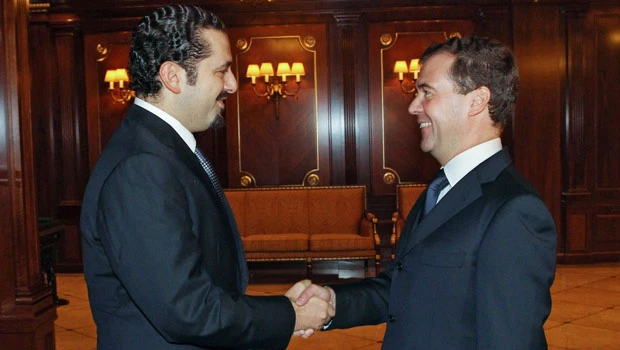
- BEIRUT: Russia will provide the Lebanese army with free helicopters, tanks and munitions in a deal that will boost the country’s poorly equipped military, officials said Tuesday.
The announcement comes at a time when military assistance to Lebanon is under scrutiny after US lawmakers demanded assurances that American aid will not fall into the hands of Hezbollah.
Lebanon’s Prime Minister Saad Hariri said the Russian aid includes six helicopters, 31 tanks, 130 mm caliber cannon shells and about half a million different munitions for medium sized weapons and artillery shells. The statement, which followed Hariri’s talks in Moscow with Russian Prime Minister Vladimir Putin on Tuesday, did not say when the aid would be delivered.
Lebanon’s 60,000-strong military has long been poorly equipped and has virtually no air force — except for about 30 unarmed helicopters and several 1950s-era British-made Hawker Hunter jets — and no effective air defense system.
Archenemy Israel routinely flies reconnaissance missions over Lebanon unchallenged.
The news about the Russian aid came just days after two key members of the US Congress released their holds on $100 million in US military aid to the Lebanese army.
The lawmakers suspended the aid on Aug. 2 amid growing concern in Congress that American-supplied weapons could threaten Israel and that Hezbollah may have influence over the army.
A day later, Lebanese soldiers opened fire on Israeli troops in a firefight that lawmakers said only reinforced their concerns. Two Lebanese soldiers, a Lebanese journalist and a senior Israeli officer were killed.
Republican congressmen Howard Berman and Nita Lowey said they decided to free up the money after the Obama administration had given them assurances in classified briefings that the aid bolsters both Lebanese and US national security and would not be hijacked by Hezbollah militants to threaten Israel.
US State Department spokesman P.J. Crowley said Monday the US will be now working “aggressively with the government of Lebanon to obligate our programs with that country for this year.” “Now that holds have been lifted, we have the ability now to move forward and we’ll do so very rapidly,” he said.
Lebanon is not entirely dependent on US military assistance, and has turned to Russia and Arab governments for assistance in the past.