
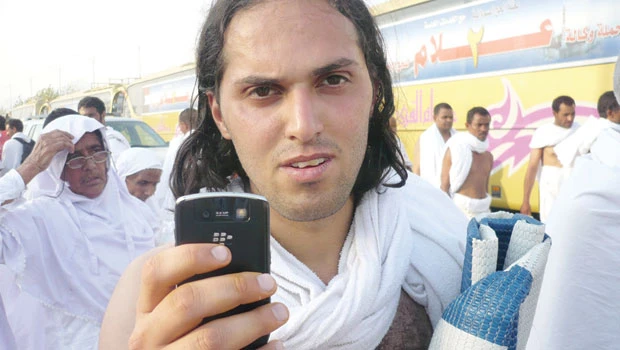
- MINA: Technology has affected all walks of life.
- Not only has it made day-to-day life easier, but it has also changed the way we perform our religious duties.
Earlier, when one planned the pilgrimage, the biggest worry was to do it correctly and if in the course of pilgrimage any mistake happens then how to rectify it.
So people used to carry a whole lot of Islamic literature and even notes from muftis and those who had done the pilgrimage earlier, said one pilgrim, who was turning pages on his iPad to get to know the correct way of performing Haj and about the prayers to be made in the holy sites.
"Ten years ago, when my father was packing his bags for Haj, he had all the essentials: clothes, money and a bit of food - but when it came to prayer manuals, something was wrong," said Mohammed Ibrahim, a tech-savvy Jordanian pilgrim. "I remember him taking all these books and photocopies and notes. It became too much for him to take care of."
But that was the year 2000. Here comes 2010, and today's pilgrims needn't worry about forgetting any of their prayer manuals. There's an app for that.
It covers everything from what pilgrims should pack to what they're allowed to do while on the pilgrimage. And if you forget any of your prayers, don't worry. The MP3 audio files have you covered.
Certainly, technology is changing the way pilgrims perform Haj. And rather than turning away from it, Saudi officials are embracing it wholeheartedly because their goal is to make the pilgrimage as comfortable and accessible as possible.
Inside the Grand Mosque, smart phones are enriching pilgrims' experience. "I have taken hundreds of pictures in Makkah, Madinah and Arafat.
But my father does not have any such pictures to share with us," said Ibrahim.
However, he agreed that for some people taking pictures at the holy places is not a good idea.
Some pilgrims who take guidance from online sites feel they have made things better.
"Availability of online guidance has made performance of Haj easier for pilgrims.
People now log on to a galaxy of Islamic sites to seek guidance and to know fatwa about major Haj-related issues," said Waqar Ahmad Yusufi from London.
Not only that, pilgrims are making use of modern technology to make their pilgrimage comfortable.
Even the Saudi government is applying all modern technology and equipment in making arrangements for Haj. All government-licensed buses now have GPS technology. Officials can monitor, in real time, where each bus is and how fast it is traveling. If a bus breaks down, a team is immediately dispatched to clear the road.
Perhaps the biggest change has been in Mina, the site of deadly stampedes in the past. Apart from building the multilevel Jamrat Bridge to ensure similar tragedy never occurs again, the authorities have completely redesigned the area.
A closed-circuit camera system now monitors all pilgrim movements in real time. At the slightest evidence of another bottleneck, traffic controllers move in to clear the scene.
In the air, the Saudi Telecom has installed more than 1,000 cellphone signal transmitters and receivers in Makkah and nearby areas. The idea, according to one of the STC officials, "is to guarantee effective cellphone coverage for all of the religious sites."
All of this has serious implications for Haj itself.
Some see it as an encroachment into what is, essentially, a religious event.
"How can you focus on circling the Kaaba or concentrate on prayers when the guy in front of you is talking to his wife on his cell phone?" said pilgrim Imran Zahid.
"There can definitely be a disturbance. This is a spiritual journey, a journey to develop ourselves from within. All that Internet stuff can wait."
But he agreed that if the mobile phone is used when absolutely necessary to seek guidance then there is no harm.
But Ibrahim sees things slightly differently. "Having all your books, supplications, and Qur'an in one place allows you to maximize the time you spend in the holy places," he said. "But like everything else, it has to be used appropriately."
As smart phones and tablet PCs become more popular, Ibrahim expects Haj apps to be used more widely.
Just about the only thing they can't do is perform the rituals for you. But somewhere out there, you can bet there's an app in the works for that, too.
"Instead of running after one mufti to another for Haj counseling, I preferred to log on to www.IslamiCity.com which provided answers to all my queries," said Adnan Jaber, a Jordanian.