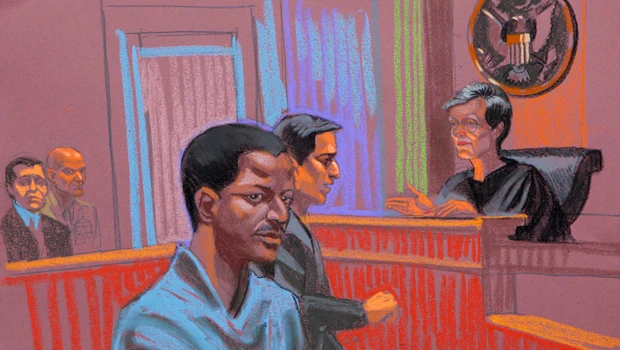
- WASHINGTON: Ahmed Khalfan Ghailani, a 36-year-old Tanzanian who was at one time detained at the US military prison at Guantanamo Bay, Cuba, was acquitted Wednesday by a New York jury of all but one of 285 charges stemming from his alleged participation in the 1998 bombings of US embassies in East Africa.
The single federal charge on which Ghailani was convicted, destruction of US property, carries a minimum prison sentence of 20 years. Ghailani’s defense attorney, Peter Quijano, says his client intends to appeal the sentence.
During the trial, prosecutors claimed Ghailani had helped Al-Qaeda operatives purchase a vehicle and explosive chemicals used in the nearly simultaneous Aug. 7, 1998 suicide attacks in Dar es Salaam, Tanzania, and Nairobi, Kenya. Later, federal officials charged, Ghailani fled to Pakistan and then Afghanistan, where he served as a cook for Al-Queda leader Osama bin Laden, the mastermind behind the Sept. 11, 1991 skyjackings that resulted in the destruction of the New York World Trade Center.
Ghailani was captured in Pakistan in 2004, and held and interrogated in an undisclosed overseas detention facility managed by the US Central Intelligence Agency. In 2006, he was transferred to Guantanamo. Last year, Ghailani was transferred to New York prepare for trial.
Legal observers said the Ghailani verdict affirms that the American system of justice, sometimes referred to as “the great leveler of society,” is capable of objectively determining guilt or innocence, even in a case as sensitive and politically charged as one involving terrorism. US District Judge Lewis Kaplan, while dismissing the jury which deliberated Ghailani’s fate for seven days, commended the anonymous 12 men and women for showing that justice “can be rendered calmly, deliberately and fairly by ordinary people – people who are not beholden to any government, even this one.”
The outcome of the Ghailani trail may make it more difficult for President Barak Obama to fulfill his pledge to close the prison at Guantanamo: Last year, the White House made the politically unpopular decision to try terrorism suspects in civilian courts instead of before military tribunals. Ghailani’s single conviction will likely make it more difficult to convince Congress – which, after this month’s election, now favors the political opposition – to vote for the closure of the controversial detention facility and allow terror suspects to be moved into American jails.
The trial at the Lower Manhattan courthouse was seen by many political observers as an initial foray of Obama’s intention to try additional terrorism suspects on US soil -- notably Khalid Shaikh Mohammed, the confessed planner of the 9-11 attacks. This plan may now be in jeopardy.
The outcome of Ghailani trial also underscored some of the human rights challenges facing prosecutors as they prepare similar terrorism cases. Ghailani, like many detainees still housed at Guantanamo, was interrogated while being subjected to procedures widely denounced as torture. During Ghailani’s trial, Judge Kaplan barred evidence obtained during these interrogations, much of it viewed as pivotal to the prosecution’s case against Ghailani.