
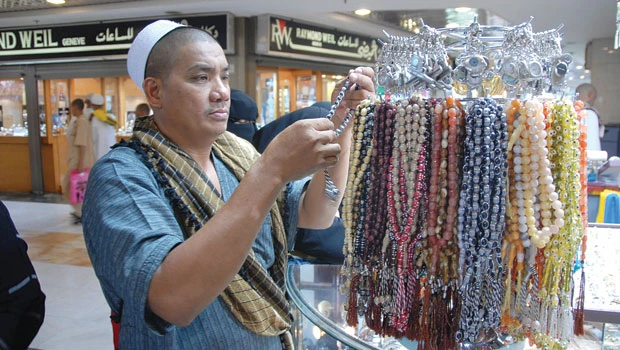
- JEDDAH: The Haj season is a golden opportunity for gift shops to make money.
- Before and after the five-day pilgrimage, pilgrims — who come from across the world — often buy souvenirs for their families and loved ones back home.
Items with pictures of the two holy mosques that pilgrims buy are usually on top of the list. Such items remind pilgrims of the beautiful memories they experienced during their historical visits to the Kingdom.
Jeddah is also visited by pilgrims before and after Haj. One popular location is the downtown Balad area of the city, which is also frequented by street hawkers who try doubly hard to attract pilgrims.
Although peddling on the streets is illegal and many of these hawkers risk having their goods confiscated if caught by municipality officials, most continue taking the risk to earn a quick buck. The goods they sell are usually purchased in bulk and then sold cheaply on to pilgrims. The items they sell include hats, prayer beads, prayer mats and other small bric-a-brac.
Mohammed Zanada, a Yemeni shopkeeper, said he is selling some special items for this year’s pilgrims. “We’ve got some unique gift items on sale. We’ve got some prayer mats with pictures of Makkah and Madinah, calligraphy and Islamic motifs on them. These mats with Islamic inscriptions are particular favorites among pilgrims,” said Zanada.
“We’ve purchased three types of prayer mats. We’ve got an expensive type that is made in India. It is handmade and decorated with colorful silky Islamic inscriptions; it costs SR100. The original price is SR80,” he said, adding that some pilgrims prefer the ordinary prayer mats. “They prefer the cheaper ones, which cost between SR10 to SR20 each,” he said.
“I came here on the first of Dul Hijjah to sell prayer beads. I have different colors and types of them. The price varies depending on the type. For example, the good ones I have will fetch SR80 a dozen. The cheapest types cost SR50 and sometimes SR25 a dozen,” he said, adding, “This is not my proper job. I work as a driver, but I want to benefit from Haj and earn some extra money.”
Mujahid Muzher is a Bangladeshi street peddler selling hats in the Balad district. “I only sell hats during Haj. Many pilgrims buy hats for their families back home. I’ve got a large number of hats and people like them. I have Turkish, Iranian and Saudi ones. The prices differ according to the type. A high-quality hat costs SR30 while the cheaper ones cost between SR10 and SR25,” said Muzher.
“I expect to earn SR400 a day. In normal days, the profit will not exceed SR100 per day,” he added.
The Kingdom is also renowned for the quality of oud that is sold here and so many pilgrims consider this perfume the best gift they could possibly buy for relatives in their home countries.
“Most pilgrims are interested in buying oud, but the prices are too high for most people,” said Ammar Hassan, a Yemeni shopkeeper. “I sell small bottles of oud that is of a cheaper quality and quality, but affordable to the average pilgrim. Bakhour and henna are also popular among pilgrims. They buy large quantities regardless of the price,” he added.
Silver rings embedded with fake stones are also very popular among pilgrims. “We have different types of rings on offer. Many of them are silver and have different precious stones embedded inside them. We have three qualities — Italian ones, Iranian ones and Yemeni ones,” said Sameeh Arshad, an Indian shopkeeper. “Pilgrims prefer to buy the Italian ones although they are expensive. The Italian ones cost SR60. The Iranian and Yemeni rings cost between SR20 and SR45,” he added.
Honey is also very popular. “Although the price of honey is very high, pilgrims continue to buy no matter what. They believe honey can be used to treat many types of diseases,’ said Hussain Radi, the Yemeni owner of an herbal shop.
“They believe that the honey sold in the Kingdom is original unlike other brands of honey sold in other countries. Despite the high price, they still buy it. Good honey costs between SR300 and SR600 a kilo.”
He added that most pilgrims know their honey and come asking for certain types. “They know the different types of honey and their names very well,” he said.
On sale are also cameras with special free bags with the words Haj Mabrour written on them. “These cameras are available at special prices for pilgrims. We get lots of pilgrims from different countries wanting to buy cameras. They trust the brands available in Saudi Arabia,” said Tariq Ali, a shopkeeper at a popular store that sells electronic items. Small MP3 players are also available, including little gadgets that can recite Quranic verses in 25 languages. “Many pilgrims buy these gadgets before Haj. They help them to read the Qur’an in a language they understand. They also buy them for their friends and relatives as souvenirs,” said Umran Hassan, a Pakistani shopkeeper.