- KABUL: The United States is sending battle tanks to Afghanistan next month for the first time in the drawn-out war against Taleban-led insurgents, the US military and NATO-led forces said Friday.
A company of 14 M1A1 Abrams tanks and about 115 Marines is set to deploy in Helmand province in Afghanistan's southwest, long a Taleban stronghold, an official with the NATO-led International Security Assistance Force (ISAF) said.
The 68-ton tanks will give Afghan and US-led forces more firepower and maneuverability while helping limit civilian casualties, the official said. The Abrams' optics will also help in finding Taleban strong points and disrupting night-time placement of homemade bombs, a key guerrilla weapon.
The battleground up until now has not allowed the deployment of tanks in any numbers because of the mountainous terrain, as well as the patchwork of small farmland enclosed by irrigation ditches and mud walls in the south.
The wider expanse of desert west of Helmand is more suitable for tanks. ISAF has also been trying to keep the deployment low-key.
The Washington Post newspaper earlier said Gen. David Petraeus, commander of US and NATO forces in Afghanistan, approved the deployment last month. Canadian and Danish troops have used tanks in southern Afghanistan.
The Abrams tank, designed to fight Soviet forces during the Cold War, carries a crew of four. Its main armament is a 120mm gun and its top speed is 67 kph, according to the US Army website.
According to Global Security, a defense website, the Abrams' 1,500 horsepower engine uses 3.8 liters for every kilometer. A single tank takes 10 minutes to refuel.
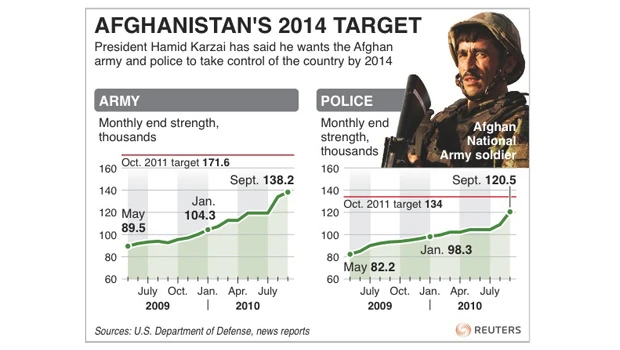
The head of NATO said Friday the alliance would start turning security over to Afghan forces next year under a plan NATO officials say will allow for substantial troop withdrawals by the end of 2014.
Some NATO and Pentagon officials have expressed doubt that the 2014 deadline can be achieved because of the rising threat posed by the Taleban to Afghanistan's weak government.
But NATO Secretary-General Anders Fogh Rasmussen said before the start of a two-day summit in Lisbon that the 28-nation alliance was committed to the target date, and would leave a smaller staff to train the Afghan forces.
US President Barack Obama, who will have talks with Afghan President Hamid Karzai during the summit Saturday, backed the decision to start the security handover in 2011 and called for moves toward a reconciliation with the Taleban.
"We will announce that the transition to lead Afghan responsibility (for security) is about to start in 2011," Rasmussen said after talks with Portugal's president. "We hope this process will be completed by the end of 2014 so that the Afghan security forces can take responsibility all over Afghanistan."
NATO leaders will formally announce the exit strategy during the summit, hoping to draw a line under a war seen as going badly for the United States and its allies.