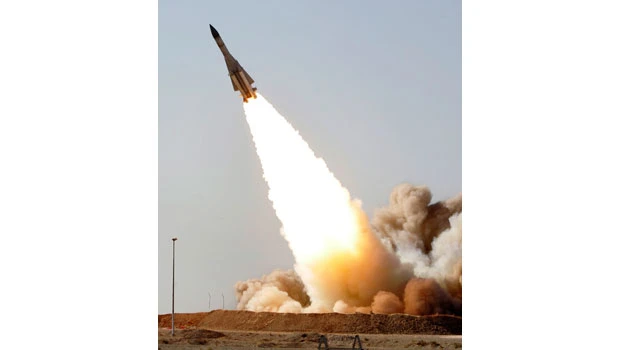
- LISBON/ANKARA: France's President Nicolas Sarkozy said Saturday that Iran poses the main threat of the type of rogue attack that NATO's planned anti-missile defense shield is designed to foil.
“No name appears in the documents made public by NATO, but let's call a spade a spade: today's missile threat, it's Iran,” he told reporters at the NATO summit in Lisbon.
The 28-member alliance had earlier agreed on a plan to design a network of radars and interceptor rockets to shoot down missiles targeted at NATO member states, and to invite former rival Russia to take part.
Several allies have in recent years expressed concern at Iran's ballistic missile program, but fellow NATO member Turkey insisted that its neighbor not be singled out as a threat in official policy documents.
President Abdullah Gul of Turkey says the NATO summit agreement to build a missile shield over Europe has met Ankara's demands. An alliance member that maintains close ties to neighboring Iran, Turkey had refused to let NATO name Tehran as a threat.
The state-run Anatolia news agency quoted Gul as saying Saturday that the agreement “was within the framework of what we wished. We are pleased about this.” Under it, a limited system of US anti-missile interceptors and radars already planned for Europe — to include interceptors in Romania and Poland and possibly a radar in Turkey — would be linked to expanded European-owned missile defenses.
NATO leaders agreed on Friday to develop a missile defense shield linking systems in the United States and Europe to protect member states against long-range attacks from regions such as the Middle East.
US officials said the protective umbrella, which will be deployed in stages from next year until 2020, would be capable of intercepting long-range and intercontinental ballistic missiles.
US interceptor missiles and radar will be stationed in Europe under a plan which NATO officials say will require the 28 NATO states to invest 200 million euros ($280 million) to link existing anti-missile systems to the US system.
“It offers a role for all of our allies. It responds to the threats of our times,” US President Barack Obama told reporters at the NATO summit in Lisbon.
NATO and Russia agreed on Saturday to cooperate on missile defence and other security issues, and hailed a fresh start in relations strained since Russia’s intervention in Georgia in 2008.
NATO Secretary-General Anders Fogh Rasmussen said the meeting represented a “fresh start” toward more trust and cooperation between the two sides, which froze ties after Russian forces invaded NATO ally Georgia.
Russian President Dmitry Medvedev said a “period of difficult, strained relations has been overcome.”
“We have large-scale plans, we will be working in all areas, including European missile defence,” he told reporters.
Obama said the plans would be built around the US system known as the Phased Adaptive Approach which he announced last year.
This will involve the stationing of ship-based interceptors in the Mediterranean from 2011, followed by land-based interceptors in Romania from 2015 and in Poland from 2018. The United States is also keen to station a forward radar in Turkey, another NATO member state. NATO officials previously said the system was intended to counter missile threats from the Middle East, in particular Iran. By 2020 it will be able to defend against the longest range Inter-Continental Ballistic Missiles.
But the sources said leaders would continue to make clear where they believe the main danger comes from, and a US official highlighted the threat from the Middle East.
“This is a phased system and if the threat of long-range missiles, ICBMS, develops, this system will be capable of actually intercepting those missiles coming from the Middle East,” said Ivo Daalder, the US ambassador to NATO.
NATO diplomats have said details, including command and control, will be worked out later.
They said expectations were that the shield would be operated through NATO's existing command structure in tandem with national commands, as is already the case with air defense.