- SEOUL/NEW YORK: South Korea said on Tuesday it would retaliate with missile strikes against the North if faced with “further provocations.”
North Korea fired barrages of artillery onto the South Korean island of Yeonpyeong near their disputed western border Tuesday, setting buildings ablaze and killing at least two marines.
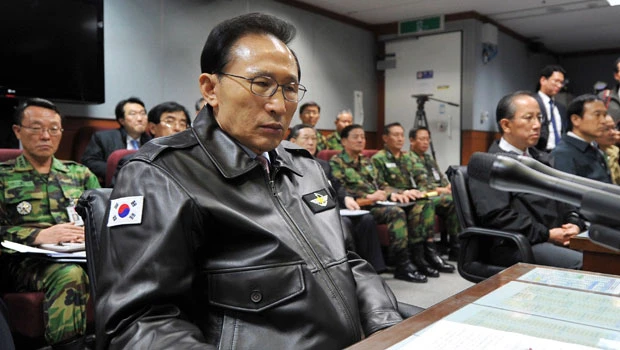
South Korean President Lee Myung-bak, who convened an emergency security meeting shortly after the initial bombardment, said that an “indiscriminate attack on civilians can never be tolerated.” “Enormous retaliation should be made to the extent that (North Korea) cannot make provocations again,” he said.
The hour-long skirmish began when Pyongyang warned the South to halt military drills in the area, according to South Korean officials. When Seoul refused and began firing artillery into disputed waters, albeit away from the North Korean shore, the North retaliated by bombarding the small island of Yeonpyeong, which houses South Korean military installations and a small civilian population.
“I thought I would die,” said Lee Chun-ok, 54, an islander who said she was watching TV in her home when the shelling began. Suddenly, a wall and door collapsed.
Meanwhile, the supreme military command in Pyongyang threatened more strikes if the South crossed their maritime border by “even 0.001 millimeter,” according to the North’s official Korean Central News Agency.
A statement from the North said it was merely “reacting to the military provocation of the puppet group with a prompt powerful physical strike,” and accused Seoul of starting the skirmish with its “reckless military provocation as firing dozens of shells inside the territorial waters of the North.”
UN Secretary General Ban Ki-moon called on Tuesday for restraint by the two Koreas after condemning the attack by the North, a spokesman said. “The secretary general condemns the attack and calls for immediate restraint,” said a spokesman for the UN leader in a statement.
No UN Security Council meeting will be held on North Korea's strike, the British president of the council said. “No meeting has been requested,” British Ambassador Mark Lyall Grant said when asked about the new tensions and global alarm over the latest incident.
The Pentagon said it was too soon to discuss ways the US military might deter North Korea from another attack. Pentagon spokesman Dave Lapan said no additional US military assets had been moved into the region following the attack and refused comment on whether US forces in South Korea were on a heightened state of alert, referring reporters to local commanders.
The White House condemned the attack. In a statement released before dawn, Press Secretary Robert Gibbs called on North Korea “to halt its belligerent action and to fully abide by the terms of the armistice agreement,” the 1953 pact that ended the Korean War.
Gibbs said the White House “is in close and continuing contact” with the South Korean government.
“The United States is firmly committed to the defense of our ally, the Republic of Korea, and to the maintenance of regional peace and stability,” he said. A senior administration official said President Barack Obama was woken up shortly before 4 a.m. (0900 GMT) by National Security Adviser Tom Donilon, who updated the president on the situation.
None of the more than 28,000 US troops stationed in South Korea were involved in the military drills, said Lt. Col. Mark Ballesteros, a Pentagon spokesman in Washington.