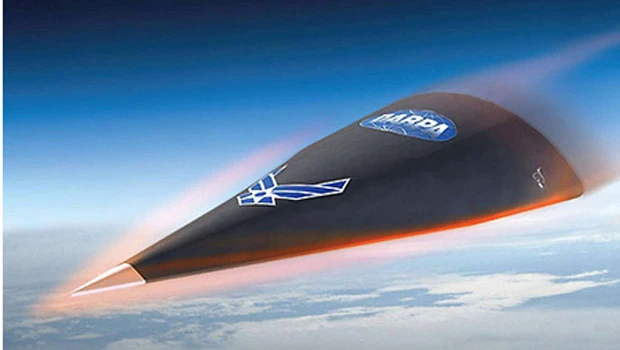
- WASHINGTON: Six months after its maiden flight ended in the aircraft self-destructing, the US Defense Advanced Research Projects Agency, DARPA, announced this week that it knows what went wrong with the Falcon Hypersonic Test Vehicle, or the “Falcon HTV-2.”
The Falcon HTV-2 is designed to skim the top of the atmosphere just below space, and is a key element of the Pentagon's Conventional Prompt Global Strike (CPGS) capability — a program to create non-nuclear strategic weapons that can strike conventionally anywhere in the world in less than an hour.
In a procedure called “clamshell payload fairing release,” the launch missile deploys the plane, which is then supposed to glide above the Earth at more than 13,000 miles per hour — more than 20 times the speed of sound.
Defense scientists said the Falcon HTV-2 experimental super-weapon crashed after its first flight this year when the autopilot deliberately directed the unmanned glider into the ocean as a safety precaution.
In a statement last week, DARPA said the first test flight April 20 ended when the autonomous onboard control system — the computer autopilot flying the futuristic super-weapon — “commanded flight termination.”
“When the onboard system detects (undesirable or unsafe flight) behavior, it forces itself into a controlled roll and pitch over to descend directly into the ocean,” DARPA spokesman Eric Mazzacone told reporters.
The DARPA statement said that an independent engineering review board concluded the probable cause of the anomaly was a “higher-than predicted yaw, which coupled into roll, thus exceeding the available control capability at the time of the anomaly.”
DARPA said telemetry assets lost signals from the HTV-2 because of “flight control limitations to operate at the angle of attack the vehicle was programmed to fly for the speed and the altitude of flight.”
The $308 million Falcon HTV-2 is a suborbital near-space vehicle launched on a Minotaur rocket, a solid-fuel booster built from a decommissioned ballistic missile.
In spite of losing the aircraft so early in its flight, DARPA still counts the HTV-2 test as a success, with “the first ever use of an autonomous flight termination system” and the first launch of the Minotaur IV booster.
DARPA said a non-agency review board “reviewed and concurred with” a series of remedial measures proposed for a second test flight next year, but some analysts said the results of the first one raise questions about the way the program has been run.
The report said the HTV-2 was being produced by Lockheed Martin, using technology developed for a precision-guided, maneuverable warhead called ER.
A second Lockheed Martin-built prototype will fly in late 2011, but not before some adjustments are made, though there will be no major changes to the vehicle or its software, according to David Neyland, DARPA’s tactical technology office director.
“Engineers will adjust the vehicle’s center of gravity, decrease the angle of attack flown and use the onboard reaction control system to augment the vehicle flaps when HTV-2 flies next summer,” Neyland told reporters.