
- It’s that awful time of year again.
- Parents all over the Kingdom are struggling to help their children come up with a project for the school’s annual science fair.
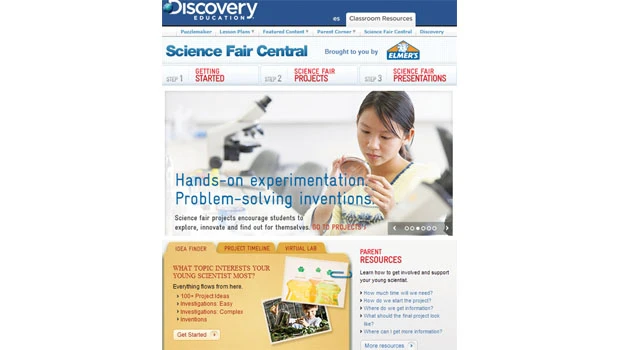
First, take a look at Discovery Education’s Science Fair Central (http://school.discoveryeducation.com/sciencefaircentral). This website is a beginner’s guide to science fair projects. The site advises parents on how to steer their children through a science fair assignment from project selection all the way through to presentation. The goal of the site is to help parents empower kids to create a project that’s a student’s creativity, rather than parental effort in disguise. Science Fair Central includes resources such as an Idea Finder, Project Timeline and even a Virtual Lab. A significant part of Science Fair Central focuses on how students can turn an innovative experiment into a high impact display. There’s even a section on how to prepare for the oral presentation — sometimes the most challenging part of the science fair.
Another great science fair project site is ScienceBuddies (www.sciencebuddies.org). The Science Buddies website is full of reference materials and Project Ideas designed to fit any student’s course of study and areas of interest. The site’s Topic Selection Wizard can recommend a science fair project idea or parents and students can browse through a list of over 1,000 project ideas. ScienceBuddies’ “Science Fair Project Guide,” is a step-by-step reference filled with helpful advice to ensure that any science fair project is a success. If there’s a problem, their “Ask an Expert” resource is an online bulletin board staffed by volunteer scientists and top high school students ready to answer any science fair project questions. Students planning to participate in advanced science competitions will find a special section of tips, techniques and suggestions at the site, which are useful in preparing for global events such as the Intel International Science and Engineering Fair (Intel ISEF).
Once students understand the key elements of science fair projects, they can look at loads of other amazing science websites for inspiration. The Howard Hughes Medical Institute (HHMI) has put together an excellent resourced called “Cool Science” (www.hhmi.org/coolscience). The purpose of the resource is to share the facts and fun of science with students of all ages. Topics such as “Air Junk,” “The One-Inch Square Project” and “The Virtual Transgenic Fly Lab,” all could be adapted to become science fair projects. For students assigned to do a “green” science fair project, take a look at the resources available through EcoKids (www.ecokids.ca) an award winning environmental education website. Need more ideas? Browse through EarthSky (http://earthsky.org), ScienceBase (www.sciencebase.com), The Science Spot (http://sciencespot.net) and the Science and Arts Gateway for Education (www.cac.cornell.edu/Education/SAGE.aspx).