
- NEW YORK: A lot has changed in the neighborhood since Domenico Pinto, owner of Ferrari Driving School, opened his business more than 40 years ago.
“This whole street used to be Italian and Greek,” Pinto said, pointing to the stores that line Steinway Street in the Astoria neighborhood of Queens, New York. “Now there are only a couple of Italian places left.”
Today, businesses whose owners have ties to other parts of the Mediterranean are taking over. In fact, so many shops and restaurants owned by Egyptians, Lebanese and Moroccans line Steinway Street between 25th and 28th avenues that the area is known as “Little Egypt,” and what is unfolding there is another chapter in the ever-changing story of American society.
“Like in the past, you see groups coming into this country because there are economic and social trends in their own countries pushing them out, so to speak, which is why they are looking for opportunities elsewhere,” said Steven Levine, coordinator of educational programs for the LaGuardia and Wagner Archives at LaGuardia Community College in Queens. “New York City, as it has always been since its founding, has been a place where people are coming to look for those opportunities.” Astoria long has been a neighborhood of immigrants adapting to their new country. First settled by non-natives in the 1650s, the area became a commercial center in the 1800s and attracted German settlers. Among them was the Steinway family, which opened the Steinway & Sons piano factory in the neighborhood in the 1870s.
Following the Germans were Irish, Italian and then Greek immigrants, all of whom still have a presence in Astoria. Most recently, Arabs are making their mark, especially on Steinway Street.
Neighborhood residents and shopkeepers say Ali El-Sayed of Egypt was the first when he opened the Kabab Café in 1987. El-Sayed was originally from Alexandria, Egypt, with roots in upper Egypt, but he found success on Steinway Street; his restaurant has received favorable reviews from publications including the New York Times.
Like many immigrants, El-Sayed chose the United States because he hoped for a better life. He chose Astoria because he could afford it.
“The reason we came to this area is the rent,” El-Sayed said as he prepared food at his small restaurant. “I knew that when I opened his place, others would follow because they think their mother's food would be better and they would try to compete.”
El-Sayed's establishment has been joined by hookah cafés, grocery stores, pastry shops, companies that cater to Arabs, and Islamic fashion stores. The Al-Imam Mosque opened on Steinway Street about a decade ago. “Little Egypt” typifies the growth of an American immigrant neighborhood.
Levine said a core of pioneers from one immigrant group will set up shop in a neighborhood, “and the services start to become available for that particular ethnic group.” Those services include ethnic restaurants, grocery stores that cater to the new neighbors and religious institutions.
El-Sayed buys his ingredients fresh daily from neighborhood markets in Astoria. Not only is he a well-recognized chef, he is a bit of a food historian. El-Sayed said thatkushari - considered by many from the Nile Valley to be a national dish - came to Egypt with workers from India when both countries were ruled by the British.
After work, El-Sayed enjoys tea and a hookah pipe with friends across the street at Egypt Café. Among them is Mohsen Badran, who lives in another part of Queens - but started smoking hookahs about four years ago and is drawn to Steinway Street. “It is good to have conversation with the people here,” Badran said, sipping on a cup of kushari tea (loose tea leaves in a glass). “During the day, you mix with non-Arabs, but when I come here, I meet others to chat and soak in the spirit.” Badran said living in a neighborhood like “Little Egypt” can be both positive and negative for new immigrants.
“When someone new comes here, he will not feel strange and not feel like a foreigner because he will learn more about tolerance and integration into the big melting pot,” Badran said. But “if you stay for too long, you don't go out and see America and the many great things this country has to offer and don't become more American, which may defeat the purpose of immigration.”
Levine said that, historically, immigrants to America overwhelmingly move on to new frontiers after a stay in a place that reminds them of home.
“Your children are going to start attending schools. You are going to be meeting people from a wide variety of different areas,” Levine said. “There can be a sense of isolation, but the history of it has always been that there has been an adaptation and an integration.” At one end of the neighborhood, just south of Astoria Boulevard, Egyptian-born Mohammed Saad serves Arab customers at his Ageba grocery and butcher market. Saad has been a neighborhood resident for 11 years and opened Ageba a year ago.
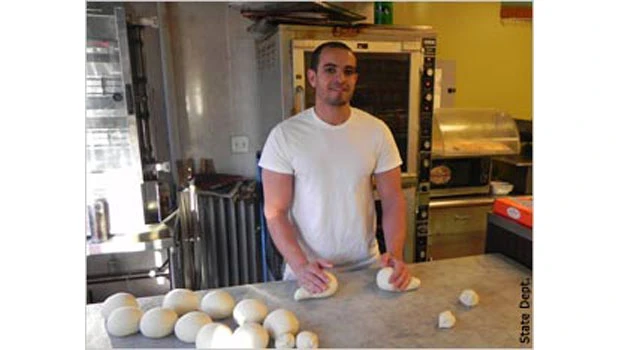
Standing in his store, Saad is flanked by a glass-enclosed, refrigerated case of halal lamb, beef and chicken and another case packed with roumi and istanbouli cheeses from Egypt. One of the biggest draws for customers is the fatayer, layered pastry in a variety of flavors that is baked on site. It reminds Egyptians of life back home. Just as food draws customers to his shop, Saad said the use of Arabic in the neighborhood attracts Arabs newly arrived to America. “At first, English is difficult for them and they stick with the Arabs,” Saad said. “All of those groups gather in their areas because they still speak their language and the language that they have isn't helpful, so they stay in an area that they know.”
Despite the neighborhood's cultural cocoon, it remains very much a part of America. Restaurant and café owners said their businesses have suffered through the economic hardships of the past three years. Rents and operating expenses continue to rise, making it tough to do business.
“Everybody is dealing with tough economic times,” El-Sayed said. “You are in America, and this is what is happening now.”
— M. Scott Bortot is a staff writer at www.america.gov