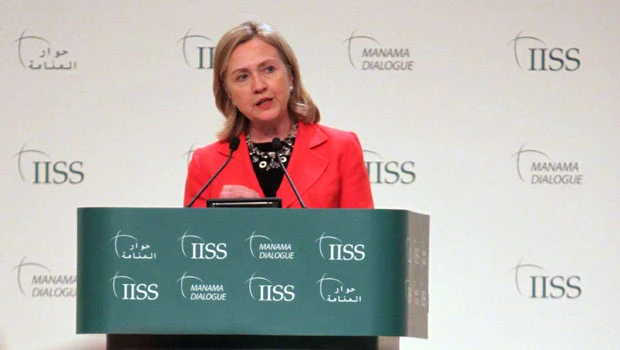
- MANAMA: US Secretary of State Hillary Clinton on Friday urged Iran to address the concern of the international community regarding its nuclear program.
"Every country has the right to develop nuclear energy but with that right comes responsibility," she said while addressing the opening dinner of the 7th IISS (International Institute for Strategic Studies) Regional Security Summit at the Ritz-Carlton. The annual event is popularly known as the Manama Dialogue.
Clinton seemed conciliatory in her tone when she said the world hoped Iran would use next week's talks to fully discuss its nuclear program.
"The entire region is concerned about your nuclear aspirations and we hope you will come to the talks in Geneva next week ready to negotiate," she said, directly addressing the Iranian leadership.
Talks between Iran and six big powers — the United States, France, Russia, Britain, China and Germany — are due to resume next week in Geneva, the first such meeting in more than a year.
The top US foreign affairs official said that Iran has a right to civilian uses of nuclear power, "but what we object to is the pursuit of nuclear weapons that can be used to threaten and intimidate their neighbors."
Speaking earlier at a joint press conference with Clinton, Bahraini Foreign Minister Khaled bin Ahmed Al-Khalifa endorsed Clinton's views and said any move toward a nuclear weapons program in the region was unacceptable.
"We do believe that every country in the region has the right to nuclear power for peaceful use," he said. "When it comes to taking that power to developing into a cycle for weapons grade, that is something that we can never accept and we can never live with in this region," he said, calling the US role "essential" to promoting the region's security and stability.
The minister also called for the need to further consolidate political and economic coordination between the two countries so as to open up new cooperation horizons for the sake of joint interests.
In his opening remarks, John Chipman, the chief executive of IISS, said by giving a powerfully intergovernmental character to the Manama Dialogue, while preserving the informality of an unofficial mechanism, the IISS could serve this twin need for official exchanges on strategic challenges conducted between groups of states flexibly assembled.
"This effort at privatized defense diplomacy works, we like to think, precisely because the IISS has no agenda in mounting the Manama Dialogue other than to create a forum where the agenda can be set by those responsible for security and foreign policy and to have those perspectives seriously and unpolemically debated with top analysts and experts," he said.