
- SAUDI Arabia has a very sound economy, great national wealth and huge natural resources.
- It would be easy to assume that there is a huge potential for the volume sale of luxury cars in the country.
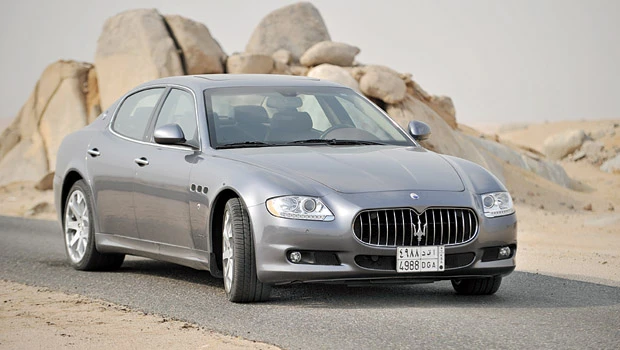
Certainly, luxury and super luxury cars sell but the streets of the main cities are not thronged with high-end Rolls Royces or Maseratis. The size of the target market for luxury cars is, relative to the size of the Kingdom’s population, smaller than the UAE.
If there is a benchmark luxury car that characterizes the price and appointments that the Saudi market likes, it is the BMW 7-series.
That said, there is certainly a taste for the exotic and Maserati concessionaire in Jeddah Mamdouh Khayyat has been selected as a pilot project for the introduction of the new Maserati corporate image. The substantial investment of faith by the carmaker coupled with a SR40 million budget from the concessionaire (SR29 million in Jeddah alone) strongly indicates their opinion of the potential for growth in the Kingdom. Dealers from around the world will visit the Jeddah showroom to see for themselves the Modena motorcar maker’s revivification of its distinctive image in a new hi-tech silver and gray garb.
However, buyers of the luxury brands are looking for value as well as image. Durability and reliability are becoming a far more part of the customer expectation of a brand. BMW are well established through their own range of cars and as the power unit providers in a range of vehicles from Rolls Royce to Morgan.
Responding to peer pressure and customer requirements, Maserati has invested heavily in making reliability a feature of its sales package across the range with a three-year free parts and labor warranty. Locally, Fast Auto-Technic has increased its service bays from three to 14 to back up the expected increase in demand. Warranty claims on the current range of cars have dropped by an amazing 78 percent to an industry low of around 22 percent — and the overwhelming majority of these according to Majid Joudah are for very minor replacements. “It is a whole new commitment to quality and reliability and it’s working,” he said. “Drive train, engine and electronics are effectively trouble free.” Depreciation is one of the lowest in the market — as little as 20 percent for a low mileage example.
It appears that the days of the exotic but fashionably eccentric unreliable thoroughbred sports car have gone, as clients worldwide and across brands want more reliability for their cash. Perhaps even a score of years ago the toolbox in the trunk for the occasional tweak to a tappet by the roadside there was still part of the sports-car ownership lifestyle, it is certainly not the case now. Certainly since the transfer of control of Maserati to Ferrari by parent company Fiat in July 1998, the historic marque has gone from strength to strength.
This was helped by the revival of the Gran Tourismo introduced in 2007 and its Cabrio stablemate. Early next year the Quatroporte Sport GTS arrives in the Kingdom. “This is a true super car, but with four doors,” enthused Joudah. “I have driven many sports sedans, but I have never found anything to compare with it.” He said that the car had been returned to the driver; the steering tuned for feedback from the road, suspension definitely sporty and insulation from the sound of engine and exhaust noise balanced so that the driver is totally involved with the car’s performance.
Although now with a weighty management team running the Maserati brand, the way the reliability of modifications were traditionally tested — and apparently still are — is wonderfully Italian.
The Modena area, home to Ferrari, Pagani Automobili, Bugati, Maserati and De Tomaso for example, is locally known as the “land of engines.” Engineers from competing companies quite naturally brag about their achievements. They meet at restaurants to compare notes and prove the prowess of their machines famously by filling the tanks with fuel, starting the engines and standing bricks on the accelerator. They then retire to a very long lunch with the engines screaming at full throttle.
Any dispute about reliability is easily settled; the owner of the first engine to break pays the bill.
There are other brands too making a name in the luxury market.
LEXUS
The Lexus RX is a luxury crossover SUV sold by Lexus since 1998. The RX series comprises multiple V6 and hybrid-powered models (such as the RX 300, RX 330, RX 350, RX 400h, and RX 450h), in either front-wheel drive or all-wheel drive versions. Three generations of the Lexus RX have been produced to date, in compact or mid-size form.
The Lexus RX has been the best-selling crossover luxury SUV on the US market since its introduction and has ranked as the best-selling luxury vehicle in the United States. The RX is the only Lexus vehicle to be produced within as well as outside Japan, with North American market RX 350s being made at the Cambridge plant in Canada.
The Lexus RX first premiered in 1997 as a Lexus concept, followed by the debut of the production RX 300 model at the 1998 North American International Auto Show. In 2003, the second generation RX debuted in the United States, and the redesigned RX 330 went on sale shortly after. Equivalent versions of the first and second generation models were sold in Japan under the Toyota Harrier nameplate until 2008. In 2006, the RX line added the world's first luxury hybrid, the RX 400h.
The redesigned third generation RX 350 went on sale in early 2009, followed later that year by the second generation Lexus RX hybrid, the RX 450h. As the earliest luxury crossover on the market, the Lexus RX has inspired similar competitors from rival marques. Based on the unibody front-engine, front-wheel drive multi-model platform used by the Lexus ES, the RX is designed to combine the functional characteristics of an SUV with ride and features of a luxury sedan. Its commercial success as Lexus' best-selling model has been attributed to the strong reliability reputation of Lexus and the RX line. The RX is offered as GX's crossover counterpart, and is Lexus' only crossover SUV.
The Lexus SC series is a personal luxury coupe sold by Lexus since 1991. The SC features a front engine, rear-wheel drive design and seating for up to four passengers. The first generation SC debuted as the V8-powered SC 400 in 1991, and the I6-powered SC 300 was added in 1992. Both first generation models were produced until 2000. The second-generation model, the SC 430, went into production in 2001. The SC 430 features a hardtop convertible design and a V8 engine. The first generation SC was largely styled in California, and the second generation SC was mainly conceived at design studios in Europe.
MERCEDES
The Mercedes-Benz SLR McLaren is an Anglo-German grand tourer jointly developed by Mercedes-Benz and McLaren Automotive, built in Portsmouth and the McLaren Technology Center in Woking, Surrey, England. At the time Mercedes-Benz owned 40 percent of the McLaren Group. Due to the presence of the automatic gearbox, front mid-engined arrangement, and its driving characteristics, some commentators classify the SLR McLaren as a GT whose rivals would be vehicles like the Aston Martin DBS V12 and Ferrari 599 GTB Fiorano. SLR stands for “Sport, Leicht, Rennsport” (sport, light, racing). Mercedes-Benz stated that they would build 3,500 SLRs over a span of seven years, with an annual production of 500 cars. The car's base price made it the ninth most expensive street legal car in the year 2008.
The Mercedes-Benz E-Class is a range of executive-size cars manufactured by Mercedes-Benz in various engine and body configurations. The E initially stood for Einspritzmotor, (German for fuel injection); a new feature in volume production vehicles at the time that the E-Class first appeared, with the E as a suffix to the engine nomenclature (e.g. 230E) in the 1950s. It was not until the launch of the face lifted W124 that the E was used as a prefix (i.e. E220) and the model referred to officially as the E-Class (or E-Klasse). At this time all Mercedes cars used fuel injection and the company felt it was not necessary to add this as a distinguishing feature. Due to the E-Class's size and durability, the cars also frequently serve as taxis in European countries. Older models like the W123 and W124 are used in Malaysia as inter-state taxis, and the W211 is used in Singapore as a taxi. Mercedes-Benz also offers special-purpose vehicles (e.g. police or ambulance modifications) from the factory.
The Mercedes-Benz S-Class is a series of large luxury sedans produced by Mercedes-Benz, a division of Daimler AG. The classification was officially introduced in 1972 with the W116 S-Class, which succeeded previous Mercedes-Benz models dating to the mid-1950s. As the flagship of the Mercedes-Benz lineup, the S-Class has debuted many of the company's latest innovations, including drive train technologies, interior features, and safety systems (such as the first seatbelt pretensioners). The S-Class has ranked as the world's best-selling luxury flagship sedan and its latest generation, the W221 S-Class, premiered in 2006 as an all-new design.
As in previous iterations, the W221 S-Class is sold in standard and long wheelbase versions - V6, V8, V12, diesel and hybrid powertrains are offered. The name “S-Class” derives from the German word “Sonderklasse,” of which “S-Class” is an abbreviation. Sonderklasse means “special class” (or rather: “In a class of its own”), and in automotive terms thus refers to “a specially outfitted car.” Although used colloquially for decades, following its official application in 1972, five generations of officially-named S-Class sedans have been produced. Past two-door coupe models of the S-Class were known as SEC and later S-Coupe. In 1998 they were spun off in a separate line as the CL-Class, however it will be re-designated as the S-Coupe for the 2011 model year.