
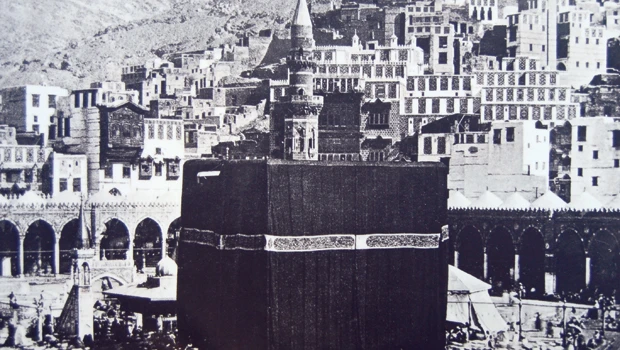
- Photography arrived in Arabia in the mid-19th C.
- as one of the first harbingers of the modernization that was about to transform the Peninsula.
Photography arrived in Arabia in the mid-19th C. as one of the first harbingers of the modernization that was about to transform the Peninsula. Old photographs included in the Saudi exhibitions, first in Paris and now in Barcelona, and in the accompanying catalog, show how important photography has been as a source for the history of the Kingdom.
When the first photographers arrived, the Arabian Peninsula preserved a series of ways of life that had not changed for centuries. These pioneer photographers proceeded to capture scenes of this passing Arabia on cumbrous photographic glass plates that record the holy cities, the small towns and the desert and their way of life.
Many people in Arabia were deeply averse to the camera and photography could be difficult, yet despite serious restraints, the early photographers produced some of the most evocative pictures of Arabia or anywhere else in Middle East.
The first photograph taken in the territory of the Kingdom is dated to 1861 and was by Col. Muhammad Sadiq Bey, an Egyptian army officer who used the earliest and most difficult of camera systems. He returned in 1880 to photograph the Haj of that year in a fuller record.
Among the valuable images that he took was a full city view of Madinah Al-Munuwarrah with its Ottoman walls intact and the courtyard of the Prophet’s Mosque (peace be upon him). At Makkah Al-Mukarramah, he photographed the Holy Haram and the Dutch scholar Snouck Hurgronje used Sadiq Bey’s stately photographs in his important book on Makkah Al-Mukarramah of 1884. Other photographs by Sadiq Bey include the Al-Ma‘la cemetery at Makkah Al-Mukarramah whose Islamic gravestones form so important a part of the present Saudi archaeological exhibition. He also photographed the pilgrims at Mount Arafat at the culmination of the Haj.
Gen. Ibrahim Rif‘at Pasha, a distinguished and pious Egyptian photographer, visited the Haramain in connection with the Haj between 1903 and 1908. He was guided by the virtuous aim of making a photographic record of Islam’s monuments for the edification of the Muslim community abroad. In this, he continued in modern technological terms the long Islamic tradition of illustrating the Holy Haramain and their architecture.
The Ottoman government actively encouraged photography to mark the completion of the Hijaz Railway in 1908, an achievement of which the Ottomans were justly proud. A French photographer, Jules Gervais-Courtellemont, and an Armenian, J.H. Hallajian, were allowed to photograph the railway’s inauguration and the pilgrimage of that year.
The Hijaz Railway was the most modern of conceptions in its day, but Hallajian captured a far older Arabian scene, one that had been repeated since the early days of Islam – the entry of the Damascus Haj caravan into Madinah Al-Munuwarrah.
It was in the spirit of this period of modernizing change that Fathers Antonin Jaussen and Raphael Savignac were given the full cooperation of the Ottoman government to visit the Hijaz to study and photograph ancient Lihyanite Dedan and Nabatean Hegra/Madain Saleh. With much ingenuity they made a methodical photographic record of these ancient sites between 1908 and 1911 and the catalog of the Saudi exhibition gives due acknowledgement to their meticulous work.
A photograph taken by Jaussen in April, 1910 near Al-‘Ula is one of the earliest showing Arabian archaeology actually under way. In a view taken in the later afternoon, Jaussen photographs his colleague Savignac who was in the process of photographing the Minaean lion reliefs cut into the cliffs above Al-‘Ula. Standing on a precarious contraption of ladders and steadied by local assistants. Savignac uses his bulky camera, the highest of high-tech of the day. In the spirit of the time, a Turkish soldier with cartridge-belt and rifle fulfils the Ottoman government’s obligation of protecting the two French archaeologists.
It is very fitting and just, one hundred years after the field research of Fathers Jaussen and Savignac that the results of their work in Saudi Arabia should have been shown in Paris in the Kingdom’s first archaeological exhibition in the West.
Between 1907 and 1912, the advance of technology was such that Mirza &. Sons, a Muslim company in Delhi, began to mass-produce post cards to be sold to pilgrims at Makkah Al-Mukarramah, Madinah Al-Munuwarrah and at Jeddah, disseminating in the process photographs of considerable historical value and skill of composition. In this period, no concern was shown with copyright and photographs by other photographers were published without attribution.
Mirza &. Sons’ production of post cards to be sent abroad by visitors had an interesting by-product, for of necessity they bore now-rare postage stamps. They thereby accidentally created an important source of information on the philatelic history of the Kingdom of Saudi Arabia and cancellation stamping in the Holy Cities.
In a very different mode are the photographs by Capt. Shakespear, one of the British emissaries to the future King Abdul Aziz bin Abdul-Rahman Al-Saud. Where Jaussen and Savignac had photographed archaeology under Ottoman guarantee of safety, Shakepear photographed under the protection provided to him by the future king.
A formal Shakespear portrait in the exhibition catalog shows King Abdul Aziz early on in his rule, taken in Kuwait in 1910. Shortly afterward, Shakespear’s photograph of the Saudi army on the march was taken and it remains the most powerful photographic image out of Central Arabia ever recorded.
Modern photographs taken specifically for the Saudi exhibition serve as a major means of contextualizing the objects displayed in Paris and in Barcelona. The photographs made for both exhibitions have been of the highest order, doing full justice to Saudi Arabia’s antiquities by showing them in their settings. They bridge the historical sequence of the objects displayed and show the visitor the immoveable monuments that lie in the more remote parts of Saudi Arabia. Many of these photographs were taken for the Paris and the Barcelona exhibitions by Humberto da Silviera in a fitting modern continuation of the engagement of Saudi Arabia with the camera.
This present series of articles in Arab News has underlined the reassessment of Arabia’s past that is stimulated by the remarkable Saudi archaeological exhibitions, Routes d’Arabie in Paris and Rutas de Arabia in Barcelona.
Yet it is far more than an important archaeological exhibition. For Saudi Arabia, it is an eloquent ambassador of the Kingdom’s strong emphasis on its antiquities and its cultural heritage. It reflects the vitality of the current efflorescence of the arts across the country which is becoming an increasingly important aspect of the Kingdom’s profile. It was to this prominent role assigned to the Kingdom’s antiquities and to their role in education and tourism that Prince Sultan bin Salman, the president of the Saudi Commission for Tourism and Antiquities (SCTA), referred in an important speech in Oxford in the summer of this year, ahead of the Paris exhibition.
For the international scholarly community that studies Arabia’s antiquities, the importance of the new Saudi Arabian archaeological material presented with such élan in this exhibition, lies in the reassessment of the whole Peninsula’s ancient past that it prompts.
In this respect, the Saudi exhibition gives many sign posts for future research. There is much to be done on the distant Stone Ages, on the Palaeolithic and the Neolithic periods, to bring knowledge to the same level of understanding that exists for these very early periods in the Gulf countries. Because of the size of the Kingdom and the interface it provides between different ancient environments, study of the Stone Age in Saudi Arabia can contribute a great deal to our knowledge of the earliest humans in the Peninsula.
The presentation of the Lihyanites and their extraordinary sculptures is a spectacular coup arising from the Saudi exhibition, bringing this barely known ancient Arab kingdom into the full light of day. As to subsequent centers of Arabian civilization at Nabatean Hegra, Qaryat Al-Faw and Thaj, they all emerge as points of conjunction between ancient Arabia’s literate incense trading societies and the Hellenistic kingdoms, the Roman Empire and the other ancient Middle Eastern civilizations.
The remarkable Zuhayr inscription, the oldest dated Islamic inscription known, and the beautiful gravestones from Makkah Al-Mukarramah’s Al-Ma‘la cemetery provide new information for the study of Islam’s greatest art form, calligraphy. As to Saudi Arabia’s Islamic pilgrimage routes, they will form a rich seam for archaeological research for many years to come.
This important Saudi Arabian exhibition is intended to travel in Europe and the Middle East after it closes in Barcelona on Feb. 20, 2011 and it will continue to stimulate interest in the past of the Arabian Peninsula in general. It should also encourage tourism to the Kingdom by visitors who will want to see Saudi Arabia’s national heritage at first hand.
The Saudi Arabian exhibition is a powerful practical means of encouraging education in history for the benefit of the public at large — Saudi and non-Saudi. Apart from its international cultural impact, the exhibition corresponds very precisely to the sustained emphasis on education that so markedly characterizes the Kingdom’s national policy.
The impressive catalogs in French, Arabic, Spanish, and English — Routes of Arabia, Turuq Al-Tijara Al-Qadima, Routes d’Arabie, Rutas de Arabia — are an enduring scholarly legacy of these international exhibitions that they accompany and they reflect decisively the Kingdom’s commitment to the study of the antiquities of its past.
For archaeologists, the Kingdom’s concern with its antiquities is very welcome, coming at a time when the capacity for Árabian studies and research is diminishing in other countries — especially the West — as distinguished scholars in the field steadily retire or pass away. The Saudi exhibition bodes well for the field of Arabian studies in the future and a resurgence of teaching and research.
The finds shown in Paris and Barcelona demonstrate the richness of Saudi Arabia’s past and underline the effort being made by the Saudi Commission for Tourism and Antiquities in treating cultural heritage and archaeological sites as a highly valued national inheritance. These outstanding Saudi Arabian exhibitions are a cause for much optimism.