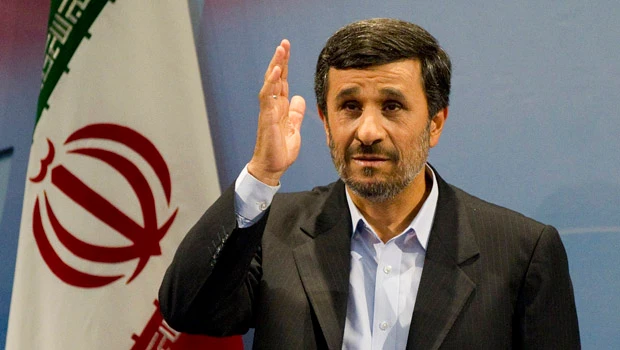
- TEHRAN: Iran is prepared to discuss a possible nuclear fuel swap at talks that resume next month, President Mahmoud Ahmadinejad said on Wednesday, but he ruled out any slowdown of its atomic program.
A day after the conclusion of a two-day meeting with the five permanent members of the UN Security Council plus Germany (P5+1), Ahmadinejad told those countries to drop any idea of curbing Iran’s quest for nuclear technology and instead invited them to help build the 20 nuclear power stations it plans.
“We are in favor of cooperation and they should come and cooperate with us and build us 20 nuclear plants,” he said in a speech to students quoted by the semi-official Mehr news agency.
The West is concerned Iran is seeking nuclear weapons capability under cover of a declared civilian atomic energy program and wants it to curb uranium enrichment. Iranian chief negotiator Saeed Jalili told reporters after Tuesday’s meeting in Geneva that: “Iran will not discuss a uranium enrichment halt in the next meeting in Istanbul.”
Iran claimed victory Wednesday in renewed talks with world powers over its nuclear program and vowed to make no concessions in the face of international pressure.
Jalili said the six world powers have accepted Tehran’s conditions for the talks as Iran’s conservative media praised Jalili for his “solid” stance.
“They joined the talks maintaining their own view, but Iran said the talks should continue based on Iran’s conditions. So they have shown serious change,” Jalili said of the talks that resumed this week.
“We frankly asked that talks should be for the sake of cooperation, and they accepted. If they remain committed to this agreement, then the talks have been successful,” he said in an interview carried on state television’s website. Iran’s media Wednesday praised Jalili over his “solid” stance and hailed the talks as a good start.
“Jalili returned from Geneva with full hands,” said a headline in Khabar, which is close to Parliament Speaker Ali Larijani.
Hard-line newspaper Siasat Rouz, which is close to the Revolutionary Guards described the talks as a “first positive step.”
“The 5+1 has to reach a great agreement with Iran,” the pro-Ahmadinejad hard-line newspaper Vatan Emrouz wrote in an editorial.
Ahmadinejad repeated Wednesday that the country would not back down on uranium enrichment. He reiterated that point and specified three red lines that Iran would not cross. “Our nuclear rights, including the continuation of enrichment, making 20 percent uranium and building nuclear plants are not negotiable,” he said.
Ahmadinejad indicated Iran might be interested in reviving a fuel swap deal, agreed in principle in the 2009 talks, which would have seen Iran export some of its stocks of low-enriched uranium in return for higher enriched material for a medical research reactor for which it cannot yet manufacture fuel.
That pact soon unraveled in disputes over conditions and Iran embarked on refining uranium up to 20 percent fissile purity itself, which it says will eventually be converted into special fuel plates for the medical reactor. “Cooperating in different fields like a fuel swap, and political, economic and security issues of the world are topics for negotiations,” he said.
The Geneva meeting — the first of its kind in over a year — ended with the head of the P5+1 delegation, EU foreign policy chief Catherine Ashton, saying the January talks would focus on “our core concerns about the nuclear issue.”
Iran says it is not involved in “nuclear talks” and insists the negotiations are aimed more generally at discussing global problems.
A French diplomatic source told Reuters the Geneva meeting was an “exchange of monologues.”
Esmail Kowsari, a member of the Iranian Parliament’s National Security and Foreign Policy Committee, said Ashton’s summary of the talks, focused on the nuclear issue, was “immoral ... As we said many times Iran will not accept negotiations under pressure, threats and sanctions,” he said.