
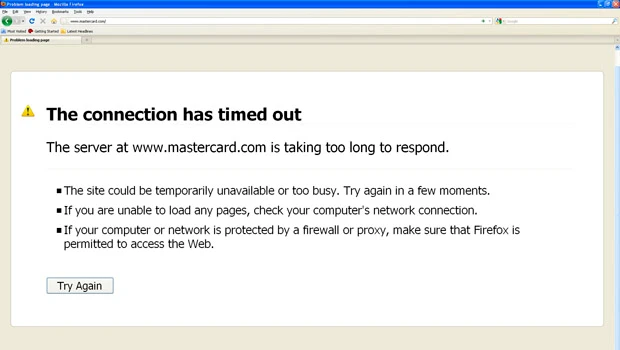
- LONDON: WikiLeaks supporters struck back Wednesday at perceived enemies of the site and its jailed founder Julian Assange, launching hack attacks against MasterCard, Swedish prosecutors, a Swedish defense lawyer and a Swiss group that froze Assange's bank account.
Internet hacktivists operating under the label "Operation Payback" claimed responsibility in a Twitter message for causing technological problems at MasterCard, which pulled the plug on its relationship with WikiLeaks on Tuesday.
MasterCard said it was "experiencing heavy traffic," but spokesman James Issokson told The Associated Press the company would not confirm whether WikiLeaks was involved.
Issokson said MasterCard was trying to restore service Wednesday but was not sure how long that would take. The website's technical problems have no impact on consumers using credit cards for secure transactions, he added.
MasterCard is the latest in a string of US-based Internet companies — including Visa, Amazon.com, PayPal Inc. and EveryDNS — to cut ties to WikiLeaks in recent days amid intense US government pressure.
The online attacks are part of a wave of support for WikiLeaks that is sweeping the Internet. Twitter was choked with messages of solidarity Wednesday for the group, while the site's Facebook page hit 1 million fans.
Offline, the organization is under pressure on many fronts. Assange, who turned himself in to London police on Tuesday, is now in a British prison fighting extradition to Sweden over a sex crimes case. Moves by Swiss Postfinance, MasterCard, PayPal and others, meanwhile, have impaired the secret-spilling group's ability to raise money.
The pro-WikiLeaks vengeance campaign appeared to be taking the form of denial of service attacks in which computers across the Internet are harnessed — sometimes surreptitiously — to jam target sites with mountains of requests for data, knocking them out of commission.
PayPal's vice president of platform, Osama Bedier, said the company froze WikiLeaks' account after receiving a letter from the US State Department "saying that the WikiLeaks activities were deemed illegal in the United States." "It's honestly just pretty straightforward from our perspective," he said, speaking at a Web conference in Paris.
Per Hellqvist, a security specialist with the firm Symantec, said a loose network of Web activists called Anonymous appeared to be behind many of the attacks. The group, which has previously focused on the Church of Scientology and the music industry, has promised to come to Assange's aid by knocking offline websites seen as hostile to WikiLeaks.
The website for Swedish lawyer Claes Borgstrom, who represents the two women at the center of Assange's sex crimes case, was unreachable Wednesday.
The Swiss postal system's financial arm, Postfinance, which shut down Assange's new bank account on Monday, was also having trouble. Spokesman Alex Josty said the website buckled under a barrage of traffic Tuesday but the onslaught seems to have eased off.
Meanwhile, the French government's effort to stop a company there from hosting WikiLeaks has failed — at least for now. The Web services company OVH, which says a client has rented an OVH server that now hosts the wikileaks.ch website, sought a ruling by two courts about the legality of hosting WikiLeaks in France. The judges said they could not decide on the highly technical case right away.
Although US officials have directed their ire at Assange, even American allies have begun to ask whether Washington shares some of the blame. "The core of all this lies with the failure of the government of the United States to properly protect its own diplomatic communications," Australian Foreign Minister Kevin Rudd said Wednesday.
"To have several million people on their distribution list for a quarter of a million cables — that's where the problem lies," Rudd added.