
- NEW YORK: Global stocks rose on Monday, lifted by US merger activity and China's moves to curb inflation without raising interest rates, while commodities advanced on China's positive economic outlook.
German bund prices fell as the prospect for stronger growth and higher interest rates in 2011 boosted the appetite for riskier assets at the expense of safe-haven government debt.
Prices of long-dated US Treasuries rose after buying from the Federal Reserve, reversing earlier losses.
Investors were relieved that China refrained from boosting interest rates after central bank inflation data over the weekend showed signs that price pressures are broadening beyond food.
China's central bank raised reserve requirements for banks instead of benchmark interest rates, easing concerns that a tightening of its monetary policy could lead to a slowdown in one of the major growth engines of the global economy.
Copper, which is used in power and construction, hit a record high.
The Shanghai Composite Index, China's benchmark gauge for stocks, closed up 2.9 percent, its largest percentage gain in two months.
European shares rose for a sixth straight day, the longest winning streak in five months, on optimism over the economy and China's rate move.
The pan-European FTSEurofirst 300 index rose 0.3 percent to end at 1,129.33 points, while MSCI's all-country world stock index rose 0.9 percent.
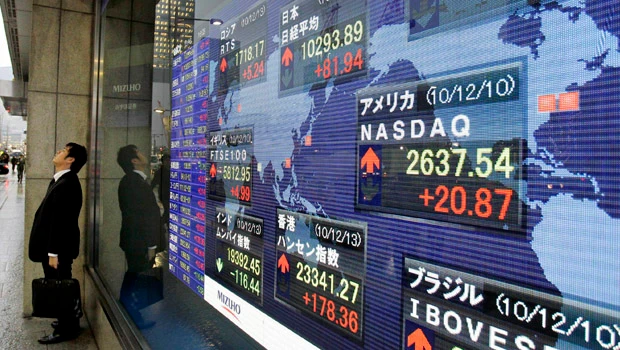
The Dow Jones Industrial Average was up 41.63 points, or 0.36 percent, at 11,451.95. The Standard & Poor's 500 Index was up 4.58 points, or 0.37 percent, at 1,244.98. The Nasdaq Composite Index was up 1.00 points, or 0.04 percent, at 2,638.54.
Gold extended gains above $1,390 an ounce and the dollar surrendered early gains against the euro.
The dollar fell broadly, hurt partly by concern that a US deal on tax cuts could swell an already large budget deficit at a time when the Federal Reserve is committed to accommodative monetary policy.
The dollar was down against a basket of major currencies, with the US Dollar Index off 0.94 percent at 79.318.
The euro was up 1.20 percent at $1.3392, while against the Japanese yen, the dollar was down 0.48 percent at 83.72.
The benchmark 10-year US Treasury note was up 10/32 to yield 3.29 percent.
Asian stocks posted modest gains, helped by a nearly 3 percent rise in Chinese shares on Beijing's latest policy moves. MSCI's Asia index, excluding Japan, rose 0.6 percent, and Japan's Nikkei average closed 0.8 percent higher.
Oil prices rose on Monday. Europe's cold snap and a cold front moving across the US Midwest into the heating oil-consuming northeast also supported oil along with the dollar's weakness.
Oil's push above $89 a barrel came after the Organization of the Petroleum Exporting Countries decided on Saturday, as expected, to maintain its production policy, and OPEC heavyweight Saudi Arabia said it still favored oil prices between $70 and $80 per barrel.
US crude for January delivery rose 73 cents to $88.52 a barrel at 11:50 a.m. EST (1650 GMT), after posting a session peak of $89.49. US crude prices reached a 26-month high of $90.76 on Dec. 7.
Total US crude trading volume was more than 321,000 lots near midday in New York, 51 percent below the 30-day average.
ICE Brent crude for January rose 75 cents to $91.23 a barrel, off a $92.30 peak. The January Brent contract expires on Thursday.