
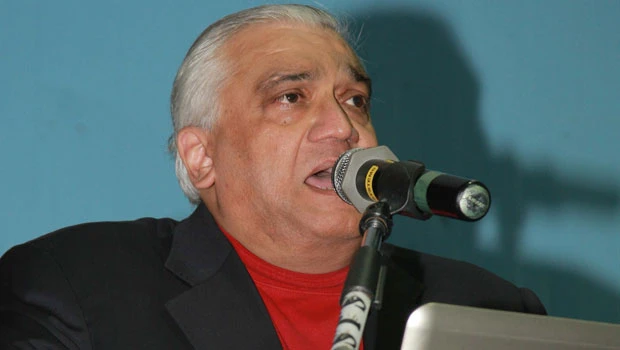
- Indian ambassador Talmiz Ahmad rejects clash-of-civilization theory in his work
JEDDAH: “Two events — my stay in Saudi Arabia during 2001-2003 and the seismic events of 9/11 — made me realize that the world as we knew had ended,” said Indian Ambassador Talmiz Ahmad as he recounted the catalyst that prompted him to write his book “Children of Abraham at War: The Clash of Messianic Militarisms.”
The ambassador was speaking at the launch of the book here on Thursday at the Indian Consulate premises. Arab News Editor-in-Chief Khaled Almaeena launched the book.
In his passionate presentation of the book, Ahmad struck at the root of the problem that has turned the world topsy-turvy while highlighting his efforts to portray what the issues were in the book, which he ends on a note of hope.
“We entered the new millennium with a sense of optimism, that technology would help us progress and that in turn would bring us together while negating the divisiveness from the previous century — a century of war,” Ahmad said in his introductory remarks.
But the post-9/11 period and the happenings around the world, said Ahmad, made him ponder over the relevance of certain events taking place globally.
Certain discourse in the West was demonizing Islam and Muslims using the broad-brush approach. “In one stroke 1,400 years of rich culture and history was being tarnished,” he said.
“This made me think of Messianic movements, which believe in the messiah, and when I delved into it I found that there was something deeper in play. It made me rethink also about Apocalypse, millennium and messiah,” he added.
Ahmad highlighted the fact that Messianic movements generally emerge in an environment of chaos and anarchy. In such situations, believers are convinced that the Messianic era is imminent and its advent is through their actions.
The movements also demonize the “enemy,” and in this conflict with “evil” they use divine sanction to commit horrendous acts of violence against the “other,” he added while explaining the rationale behind the “us against them” theory that is prevalent in this century’s first decade.
Ahmad said that his book takes a look at the Messianic movement and what its global ramifications are. “Violence has no sense at all, and I have put in vignettes in the book that explains that the violence is not political but a Messianic paradigm, why it is fueling, and will further fuel violence and what it serves,” he said.
While debunking the “Clash of Civilization” theories floated by Samuel P. Huntington and Bernard Lewis, Ahmad agreed that two powerful civilizations — the Judeo-Christian and the Islamic — are at odds because of “Secular Messianism,” that has emerged from these Messianic movements. “These two powerful forces are at war,” he said.
Ahmad said: “After completing my book I noted the ending is on a sad and pessimistic note. It was then I decided to give people some hope – and I wrote my last chapter. Here I’ve added nuggets of hope from different places, US, Europe and the Arab world stressing the efforts of the few in bringing the world closer.”
Almaeena, while praising Ahmad’s book and his detailed presentation, said the explanation was like “completing two semesters in a university — comprehensive and incisive.”
“Today, Ambassador Talmiz Ahmad provided us with an insight into the Messianic movement. Here I would like to add the history of colonialism, where the emphasis of the ‘White Man’s Burden’ was always stressed in trying to better the world. In fact, it just masked their superior attitude,” Almaeena said while dedicating the book.
“I applaud Ambassador Talmiz’ effort to end the book on a note of hope, and as an eternal optimist, I know there is hope. And this can be nurtured by dialogue. Already dialogue has taken root, but for dialogue to prosper, it needs the silent majority to speak up against the self-appointed guardians of the world order and say, ‘enough is enough,’” Almaeena added.
“I believe no group is particularly good or particularly evil, for there are good and bad people everywhere. While avoiding the trap of applying the principle of collective guilt, we should alert people to the evils of hatred, in addition to teaching young people tolerance,” Almaeena said.
Consul General Sayeed Ahmed Baba introduced the author to the gathering, while summing up Ahmad’s diplomatic and managerial skills by emphasizing his achievement of managing 11 Haj pilgrimages during his three stints as consul general and ambassador in Saudi Arabia.