
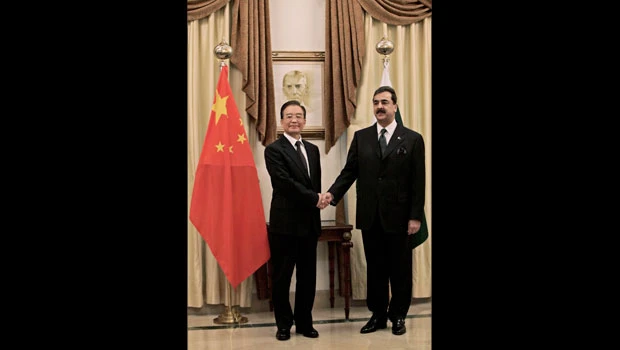
- ISLAMABAD: Pakistan was hoping for an economic boost as Chinese Premier Wen Jiabao made a rare visit Friday aimed at expanding trade ties and the flow of Chinese investment into the country.
Wen's trip — the first by a Chinese premier in five years — is also an opportunity for Islamabad to showcase its relationship with an ally it sees as offering consistent, no-strings-attached support.
The Chinese leader's plane landed under heavy security at a Pakistan air base Friday afternoon, where a red carpet was rolled out and a full honor guard was on display.
Pakistan's top civilian and military leaders, and nearly its full Cabinet, were on hand to greet Wen and his hundreds-strong delegation.
Wen, who is visiting Islamabad after a three-day stop in India, met with Prime Minister Yousaf Raza Gilani and sign business deals worth billions of dollars during his stay.
As much as Wen's three-day visit will be about investment and bilateral trade, it will also be used to reaffirm the countries' so-called "all-weather" friendship that has endured and even flourished despite Pakistan's troubles and Beijing's improved ties with New Delhi.
Pakistan is desperate for foreign investment to help create jobs for its 175 million people, and Pakistan's Foreign Ministry spokesman Abdul Basit said a push for greater business links will be a big part of Wen's visit.
"Lately we have been trying to expand the scope of this relationship because our economic and trade relations do not really depict or portray the strength of our political relationship," he said. "Our bilateral trade is close to $7 billion, which is nothing." While that number is up from $1 billion in 2000, much of the new trade consists of cheap Chinese imports into Pakistan. Islamabad will be looking for ways to balance that.
Pakistan believes China can help with a pressing need: Providing electricity for its growing cities.
Islamabad has agreed in principle to a controversial deal to purchase two nuclear reactors from China, and the two countries are working out the financial details. Beijing sees Pakistan as a future energy corridor due to its proximity to natural gas-rich Central Asian states, as well as a link to the Arabian Sea.
Wen's visit to Islamabad follows his stop in India, where New Delhi and Beijing agreed to boost trade between the two countries from $60 billion a year to $100 billion by 2015.