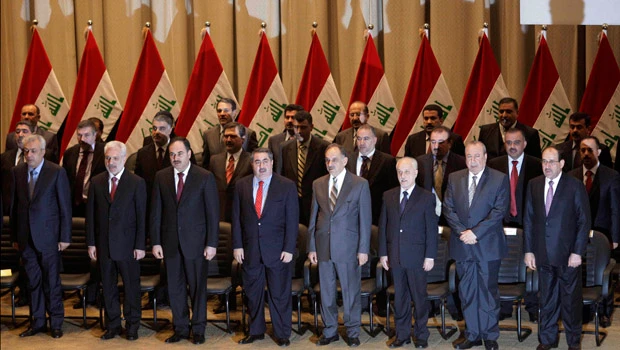
- BAGHDAD: Parliament swore in a new Iraqi government Tuesday after nine months of bitter political haggling.
- The new government led by incumbent Prime Minister Nouri Al-Maliki got off to a shaky start as disagreements among coalition partners prevented Al-Maliki from naming 13 of his 42 Cabinet ministers.
US President Barack Obama hailed the new government as a “significant moment” in the country’s history. In a written statement Tuesday, Obama said it is both a “major step forward” and a “clear rejection” of sectarian extremism.
Britain welcomed the development, saying it would allow Baghdad to start tackling the country’s problems. “I welcome the fact that a new government has now been formed in Iraq and approved by the Iraqi Parliament,” Foreign Secretary William Hague said in a statement.
Lawmakers approved 29 ministers including Al-Maliki to form the new government. The remainder of the 42-member Cabinet is made up of acting ministers who will be replaced at a later date because of ongoing disputes between coalition partners.
“The most difficult task in the world is forming a national unity government in a country where there is a diversity of ethnic, sectarian and political backgrounds,” Al-Maliki said speaking before the vote. He vowed to create a government that would combat terrorism, address the still-festering sectarian divisions and repair relations with neighboring countries.
Iraqis elections on March 7 did not give any single bloc a majority in the 325-member Parliament, leading to nine months of political jockeying to form the new government.
The new government includes members of all of Iraq’s major political and sectarian factions.
Former Prime Minister Iyad Allawi, who at one point had vowed to never join an Al-Maliki-led government, told lawmakers ahead of the vote that his bloc of 91 lawmakers would support and cooperate with the new government.
Allawi is slated to head a new council overseeing foreign policy and security related issues but there are already disagreements between his coalition and Al-Maliki’s about how much power the council will have.
Iraqiya only recently dropped its long-standing demand that Allawi should have the first shot at forming the government. Allawi’s concession came after he was assured that Sunnis will not be excluded from the government.
Other members of Iraqiya to garner top Cabinet posts were Saleh Al-Mutlaq, who will be deputy prime minister and Rafia Al-Issawi, who will be finance minister. Kurdish lawmaker Hoshyar Zebari will hold onto the influential foreign ministry post. In addition to his role as prime minister, Al-Maliki will also serve as acting defense, interior and national security minister.
Al-Maliki faces including all the country’s sects and political affiliations in the new government. He has named acting ministers to fill those ministries after disputes with his erstwhile Sadrist allies about who among the Sadrists would get Cabinet posts.
It was Al-Sadr’s support — in a deal brokered by Iran — that largely enabled Al-Maliki to build the framework for a majority coalition.
The Sadrist alliance holds 40 of Parliament’s 325 seats.
Their partnership with Al-Maliki has always been tenuous, and came as a surprise because the two had been enemies since 2008 when the prime minister launched an offensive crushing Al-Sadr’s militia in eastern Baghdad and the southern city of Basra.
The ministries still to be decided include the critical defense, interior and national security posts. Those positions are closely watched in Iraq for any sign that they are being abused by one side or another across the sectarian divide.
The Iraqiya alliance narrowly defeated Al-Maliki at the March election, garnering 91 seats to Al-Maliki’s 89 seats.
But after months of wrangling, Iraqiya could never find enough support to form a majority government.
Al-Maliki has served as prime minister since May 2006.