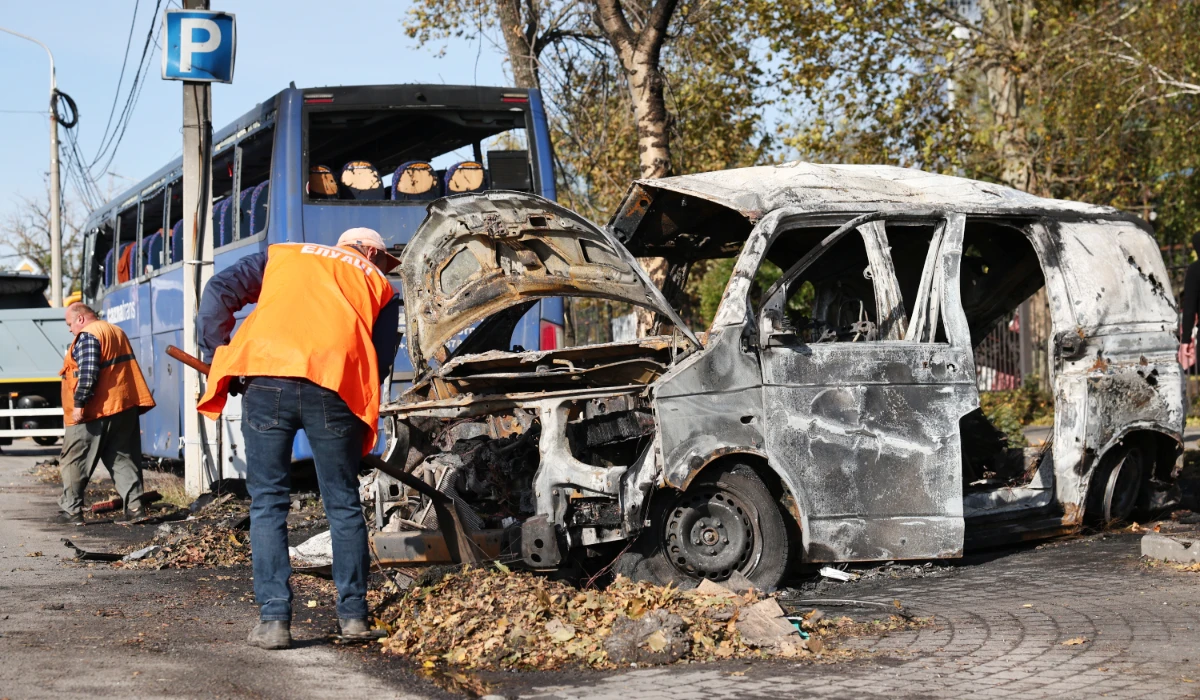
- KHAR, Pakistan: A female suicide bomber detonated her explosives-laden vest killing at least 43 people at an aid distribution center in northwestern Pakistan on Saturday, while army helicopter gunships and artillery killed a similar number of Islamic militants in neighboring tribal regions near the Afghan border, officials said.
The bombing appeared to be the first suicide attack staged by a woman in Pakistan, and it underscored the resilience of militant groups in the country’s tribal belt despite ongoing military operations against them.
The bomber struck in the main city in Bajur, a region near the Afghan border where the military has twice declared victory over Taleban and Al-Qaeda insurgents. It also came a day after some 150 militants killed 11 soldiers in a coordinated assault in the adjoining tribal region of Mohmand where the army also has carried out operations.
In Bajour, the bomber, dressed in a traditional women’s burqa, was queuing to enter the food aid distribution center in the town of Khar when she was questioned by police at a check point, local government official Tariq Khan said.
“Police asked for her identity, but she ran toward the center and lobbed hand grenades at the police,” Khan said. “She exploded herself when she reached the crowd” of about 300.
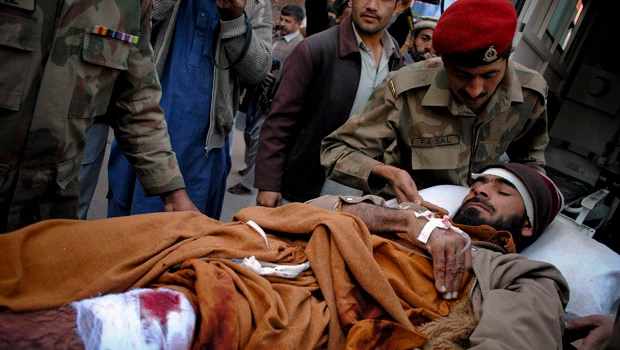
Khan said six policemen were among the 43 killed and more than 102 people were wounded, at least 30 critically.
The Pakistani Taleban claimed responsibility for the attack through its spokesman, Azam Tariq.
Tariq suggested that the victims were targeted because most belonged to the Salarzai tribe, which was among the first to set up a militia — known as a lashkar — to fight the Taleban in 2008. Other tribes later formed similar militias to resist the militants.
“All anti-Taleban forces — like lashkars, army and security forces — are on our target,” Tariq said. “We will strike them whenever we have an opportunity.” Police said the victims were from various parts of the Bajour tribal region who gather daily at the center to collect food tokens distributed by the World Food Program and other agencies to conflicted-affected people in the region. The people were displaced by an army offensive against Taleban militants in the region in early 2009.
Militants battling the state have attacked buildings handing out humanitarian aid in Pakistan before, presumably because they are symbols of the government and Western influence.
Tariq Khan and another local official, Sohail Khan, said an examination of the human remains has confirmed the bomber was a woman.
Hasan Askari Rizvi, a Lahore-based security and political analyst, said the suicide bombing appeared to be the first carried out by a woman in Pakistan.
“It is no surprise. They can use a woman, a child or whatever,” Rizvi said. “Human life is not important to them, only the objective they are pursuing” of undermining state power, he added.
Male suicide bombers often don the burqa as a disguise. In 2007, officials initially claimed Pakistan’s first female suicide bomber had killed 14 people in the northwest town of Bannu but the attacker was later identified as a man.
Akbar Jan, 45, who sustained leg wounds in the bombing, said from his hospital bed that people were lining up for the ration coupons when something exploded with a big bang.
“We thought someone had fired a rocket,” he told The Associated Press. He said within seconds he saw the ground strewn with the wounded.
“I realized a little later that I myself have suffered wounds,” he said. “Everybody was crying. It was blood and human flesh everywhere.”
Prime Minister Syed Yousuf Raza Gilani condemned the bombing and said Pakistanis are “united against them.” Bajour is on the northern tip of Pakistan’s semiautonomous tribal belt, bordering Afghanistan and the so-called “settled” areas in Pakistan. It has served as a key transit point and hide-out for Al-Qaeda and the Taleban.
Bajour and other parts of the tribal regions are of major concern to the US because they have been safe havens for militants fighting NATO and American troops across the border in Afghanistan. The US has long pressured Pakistan to clear the tribal belt of the insurgents.
The military first declared victory in Bajour following a six-month operation launched in late 2008. But the army was forced to launch a follow-up operation in late January this year and declared victory again about a month later. Still, violence has persisted in the region.
The army also has taken steps to clear Mohmand, a tribal region next to Bajour that also has witnessed militant activity. On Friday, however, around 150 insurgents attacked five security checkpoints in that region, killing at least 11 soldiers and wounding a dozen more in a show of their ongoing strength.