
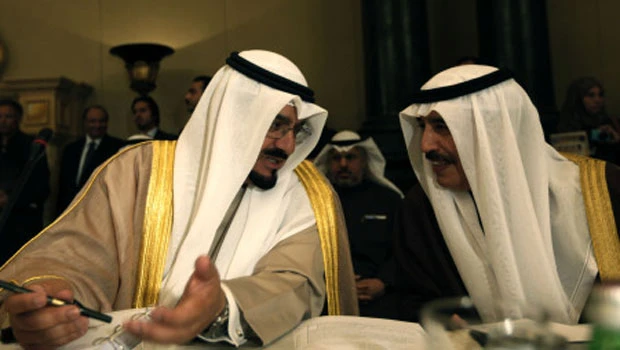
- CAIRO: The global economy can withstand an oil price of $100 a barrel, Kuwait's oil minister said Saturday, as other exporters indicated OPEC may decide against increasing output through 2011 as the market was well supplied.
Analysts have said oil producing countries are likely to raise output after crude rallied more than 30 percent from a low in May because they fear prices could damage economic growth in fuel importing countries.
European benchmark ICE Brent crude for February closed at $93.46 on Friday after hitting $94.74 a barrel, its highest level since Oct. 2008.
Arab oil exporters meeting in Cairo this weekend said they saw no need to supply more crude as stocks were high and prices had been inflated temporarily by cold weather in Europe.
Asked by Reuters if the world economy could withstand a $100 oil price, Kuwaiti Oil Minister Sheikh Ahmad Al-Abdullah Al-Sabah said: "Yes it can".
Iraq's new oil minister and the head of Libya's National Oil Corporation both told Reuters that $100 was a fair price, while Qatar's Minister Abdullah Al-Attiyah said he did not expect OPEC to increase production in 2011.
"I do not expect an OPEC meeting before June because oil prices are stable," he said.
Some delegates even called for exporters to comply better with agreed production limits. OPEC members' compliance with promised cutbacks reached 56 percent in November, according to Reuters estimates.
When asked if output could be raised, Kuwait's Sheikh Ahmad said: "No. More compliance, more compliance".
The Cairo meeting of the Organization of Arab Petroleum Exporting Countries (OAPEC) brought together Arab members of OPEC including top exporter Saudi Arabia, which has traditionally been viewed as a price moderate, as well as non-OPEC countries Tunisia, Egypt, Syria and Bahrain.
Saudi Minister of Petroleum and Mineral Resources Ali Al-Naimi said on Friday he was still happy with an oil price of $70-80 a barrel and there was no need for an extra OPEC meeting before the next scheduled one in June.
Others in the group have been pressing for a higher price, arguing that quantitative easing and a weakened US dollar that spurred gains across financial markets mean the oil price strength is partly nominal.
Egyptian Oil Minister Sameh Fahmy said the current increase in oil prices was the result of higher demand on heating fuel because of the cold weather in Europe.
United Arab Emirates Oil Minister Mohammed Al-Hamli said crude oil inventories are "quite high. It's the highest over the five years average... The market is well supplied".
Meanwhile, Iraq's newly appointed oil minister said that oil exports from the country's northern self-ruled Kurdish region would soon resume as part of the country's national oil export policy.
The Kurds have sought greater control over oil in their crude-rich region while Baghdad has argued that the oil is a national resource, under the central government's control.
Iraqi Kurds have unilaterally signed more than two dozens oil deals with Western companies that are deemed illegal by Baghdad. Exports were halted a few months after they started in June 2009 amid a disagreement over payments.
Abdul-Karim Elaibi told The Associated Press the exports from the Kurdish region would be resumed "in the coming few days." He did not set a date or elaborate on how the exports would be part of the nation's export strategy.