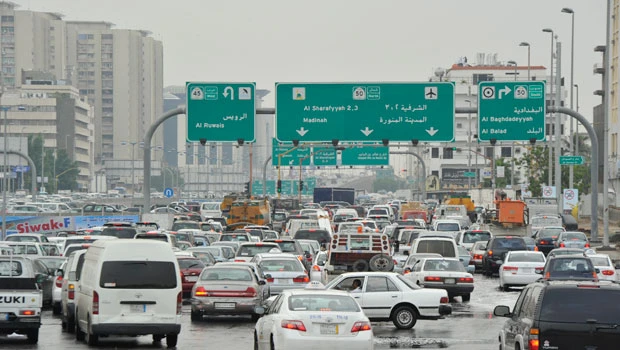
- JEDDAH: Residents awoke Wednesday morning to loud claps of thunder that heralded rain, traffic gridlock and soggy reminders of the Nov.
- 25, 2009 floods that immerse several districts of the city.
“People are still traumatized, still scared,” said local resident Khaled Saleem. “I had to ask my boss for permission to let me go because I still remember every minute of the 2009 flood.”
Students and employees were sent home early out of concern of further rain throughout the day. Civil Defense warned locals by SMS to avoid depressions and the shoreline in case the rain turned the city's usually-dry wadis into raging sea-bound torrents of mud and debris.
“I really thought there would be another flood, because Jeddah is still unsafe,” said local resident Tahani Awad. “As my husband and I drove while it was raining, we were thinking of those who died because of the flood.”
Government estimates put the Nov. 25, 2009 death toll at 123.
The Presidency of Meteorology and Environment (PME) said the chance of precipitation will continue through Friday in the western region.
While no major flooding was reported, the rains once again exposed the city's inadequate drainage system. Many residential streets became immersed with standing water. In some places large puddles will remain for days, evaporating slowly in Jeddah's cooler temperatures and becoming breeding zones for mosquitoes. The rainwater also mixes with raw sewage spilled from tanker trucks that must pump effluence out of buildings' septic systems due to a lack of adequate sewerage network in the rapidly growing city.
“I received an SMS on my mobile asking me to pick my kids up from school early,” said Mahmoud Taher, a local father of two. “It was really scary to get such a message.”
Director of emergency at the Department of Health Affairs in Jeddah Dr. Muhammad Bajubair said 13 private hospitals and 75 ERs were put on alert in case the rains caused injuries.
“So far the situation has remained normal,” he told Arab News on Wednesday afternoon. “There have been no reports about accidents resulting from the rain.”
The rains delayed some flights at King Abdulaziz International Airport. Some Saudi Arabian Airlines flights coming from Riyadh and Nas airline flights from Riyadh, Dammam and Halab (Aleppo) were diverted to Prince Muhammad International Airport in Madinah. One Saudia flight from Khartoum was diverted to King Abdullah Regional Airport in Jazan while an EgyptAir flight from Cairo was diverted to King Khaled International Airport in Riyadh.
Khaled Al-Khaibary, spokesman of General Authority of Civil Aviation, said the Jeddah airport started receiving flights after a brief halt to services owing to heavy rains.
The municipality mobilized trucks to drain water at key locations on King Abdul Aziz Road, Madinah Road, Prince Sultan Road, Obhur, Al-Falak Roundabout and Al-Ajwad and Breman districts. About 90 trucks were deployed to pump water out of depressions on main thoroughfares.
The rains also led to massive gridlock on Madinah Road, especially on the northbound lanes, as people left work and schools released students early. A considerable stretch of Madinah Road was virtually at a standstill early Wednesday afternoon.
“There was not a single police officer on the road,” said local resident Abdul Wadood Yousuf. “Traffic officials were not present at the scene to organize the traffic. They are very good at installing Saher system to fine people but when they were badly needed they were not there.”
“The roads were totally blocked,” said Egyptian expatriate Hashem Al-Imam.
“People driving in the opposite direction refused to back up or clear the road. At one point I saw two people fighting and each is refusing to move. Of course police were not there to organize anything.”
Dr. Adel Sabry, a psychiatrist, noted that some people are still suffering post traumatic stress from the 2009 flash floods, when people experienced torrents of sewage-and-debris tainted mud sweeping through their neighborhoods.
Some people who met the brute force of the flooding suffered from depression, said the specialist. Experiencing Wednesday’s rainfall may have ignited fears among residents in much the same way survivors of massive earthquakes tend to panic the next time they feel the earth shake.
“People will not forget the Jeddah disaster so easily,” said Sabry. “It will take time for some to get over it and whenever it pours, the panic and fear show on their faces.”
One traumatized resident told Arab News at the time that he counted 30 bodies in his area alone.
Thousands of people were compensated for damaged properties and families who lost relatives received SR1 million for each death. Nearly 11,000 properties were damaged or destroyed. More than 10,000 cars were destroyed. Over 4,500 people received some form of compensation, according to official estimates.