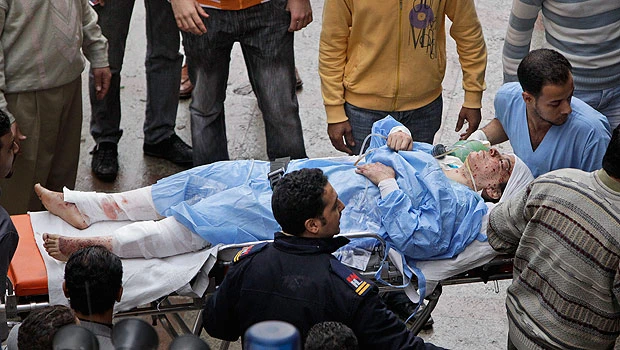
- CAIRO: At least 21 people were killed and 79 injured after a terrorist bombing ripped through a crowd of Coptic worshippers as they were leaving New Year's Mass at Saints Church in Alexandria in the first hour of the New Year.
Initial reports blamed a car bomb, but Egypt's Interior Ministry later said the attack was more likely the job of a suicide bomber who mixed with the crowd before detonation. The government said foreign elements were involved in the attack, which came in the wake of threats by Al-Qaeda militants in Iraq to expand their attacks against Christians into Egypt.
Hours after the blast, President Hosni Mubarak went on state TV and vowed to track down those behind the attack, saying "we will cut off the hands of terrorists and those plotting against Egypt's security." Aiming to prevent sectarian divisions, he said it was an attack against "all Egyptians" and that "terrorism does not distinguish between Copt and Muslim."
The president also urged Muslims and Christians to stand united to confront terrorist forces as well as those who try to undermine the country's security.
The attack drew worldwide condemnation. Custodian of the Two Holy King Abdullah, who is convalescing in New York following a back surgery, telephoned Mubarak and said Saudi Arabia would stand by Egypt in its fight against terrorism. The king had earlier in the day sent a message of condolences to Mubarak, expressing his deep sorrow over the attack.
"While expressing our strong denunciation of this criminal act, we convey our condolences to your excellency, the families of victims and people of Egypt," the king said in his communiqué. Crown Prince Sultan, deputy premier and minister of defense and aviation, sent a similar message to Mubarak.
The 57-member Organization of the Islamic Conference (OIC) and the six-member Gulf Cooperation Council also denounced the attack.
OIC Secretary-General Ekmeleddin Ihsanoglu urged the Egyptians to strengthen their unity to defeat terrorism.
The Muslim Brotherhood condemned the attack. "There are people who want this country to be unstable, and all fingers point to outside hands being behind this incident," senior group member Mohamed El-Katatni said.
Mena Adel, a priest at Saints Church, said the service had just ended, and some worshippers were leaving the building when the bomb went off about a half hour after midnight.
"The last thing I heard was a powerful explosion and then my ears went deaf," Marco Boutros, a 17-year-old survivor, said from his hospital bed. "All I could see were body parts scattered all over — legs and bits of flesh."
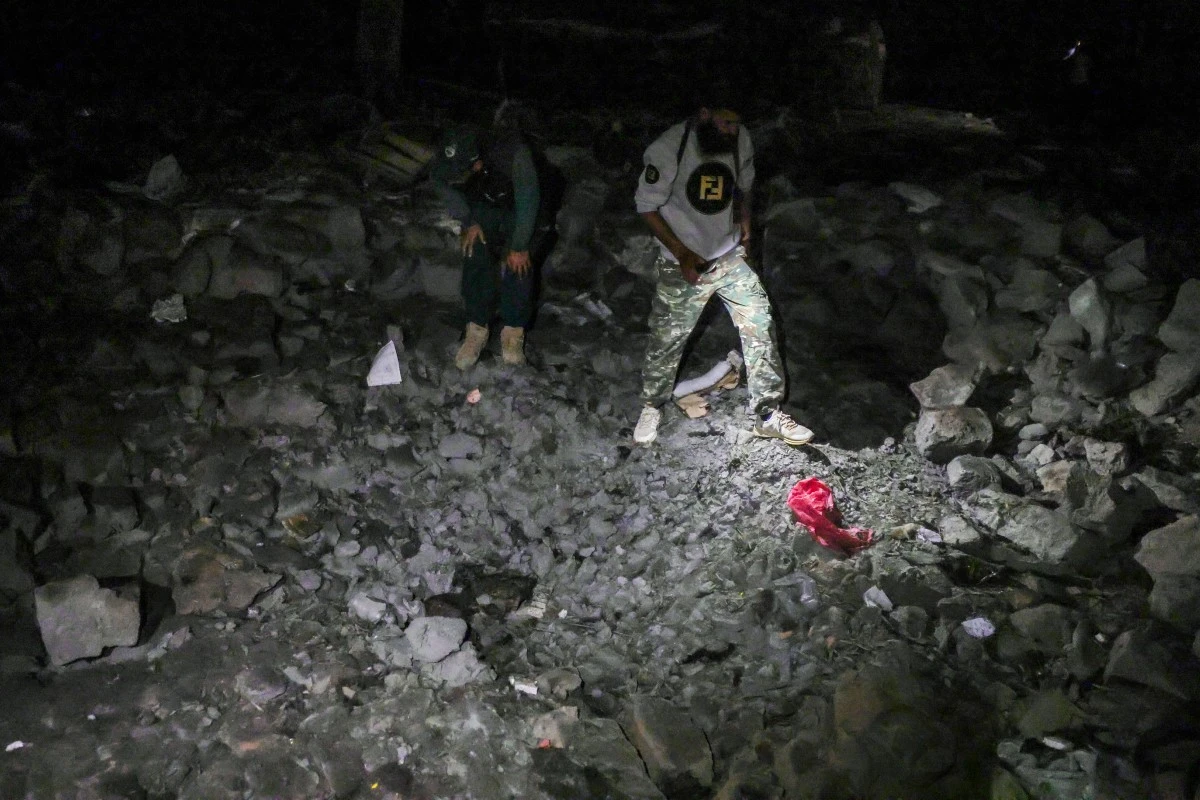
Police initially said the blast came from an explosives-packed vehicle parked about four meters from the church. But the Interior Ministry said later there was no sign the epicenter of the blast was from a car. Around six severely damaged vehicles remained outside the church, but there was little sign of a crater that major car bombs usually cause.
Alexandria Gov. Adel Labib blamed Al-Qaeda, pointing to recent threats by the terror group to attack Christians in Egypt. Both car bombs and suicide attackers are hallmark of Al-Qaeda attacks.
Soon after the explosion, angry Christians clashed with police. Some broke into a nearby mosque, sparking clashes with Muslims. Police fired tear gas to break up the clashes. But in the afternoon, new violence erupted in a street between the church and the affiliated Saints Hospital. Some of the young protesters wielded kitchen knives.
Muslim organizations inside and outside Egypt have denounced the attack. Ahmed Al-Tayeb, the head of Al-Azhar, expressed his deep sorrow over the attack and conveyed his condolences to the families of victims.
“This is a criminal act prohibited by Islam as our Islamic faith has made it a duty upon Muslims to protect churches like they protect our mosques,” he said. “This terrorist act not only targets Christians but all Egyptians,” he added.
General Prosecutor Abdelmajeed Mahmoud said the government has launched an investigation. “We’re awaiting technical reports,” he said, adding that Egyptian security forces have been quick in the past to detect people behind previous attacks.
A number of Egyptians working in Saudi Arabia denounced the bombing. “This is a deliberate attempt to destabilize the country,” said Shakir Abdul Aziz, a journalist working for Al-Bilad Arabic daily.
Abdul Aziz did not rule out the role of Mossad behind the attack as it came following the arrest of a spy of the Israeli intelligence agency in Egypt.
Hatim Hussein, who works for a major media company, said the blast would have a negative impact on national unity. He said it was the first time Christians in Alexandria were targeted. “Muslims and Christians have been living peacefully in this city for hundreds of years,” he added. “Alexandria has been a model for peaceful coexistence between followers of different faiths.”
Dr. Ashraf Al-Seesi, who works in a Jeddah medical center, blamed foreign forces for the attack, adding that Israel wanted to drive a wedge between Muslims and Christians to put pressure on the country.
Tharwat Samir, a Christian photographer, said most of the previous attacks against Christians took place in Saeed, mainly because of tribal tensions and ignorance.
“The attack in Alexandria, which is known for its religious tolerance and where Muslims and Christians live without any friction, could have been perpetrated by forces who wanted to create division among the Egyptians,” Samir said.
He referred to a similar terrorist attack in Saeed in January 2010 in which seven Christians and Muslims were killed. “Western lobbyists who wanted to add oil to fire cited the incident as evidence for the oppression of Christians in the country. Actually, the fighting took place because of political differences. Relations between Muslims and Christians in Egypt are very strong. These firecrackers will not break that relationship,” Samir added.
— With input from Galal Fakkar and agencies