
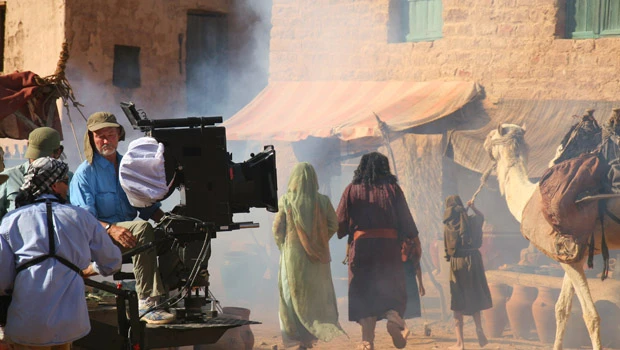
- MANY filmmakers have tried to capture the magic of Arabia without actually going there.
- Morocco is a favored location to recreate the rugged deserts of the peninsula.
But in 2005 California film maker Greg MacGillivray took up the challenge of creating the first ever feature film to be shot entirely in Saudi Arabia itself, and five years later he has brought his creation to the screen. Following a series of openings at IMAX theaters in north America at the beginning of 2010, Arabia went on to a royal premiere in London in the presence of Prince Charles, and a round of international showings in Istanbul, Quebec, Mexico City, Berlin, Valencia, Kuwait, Shanghai and Hong Kong. To date Arabia has been seen by more than 700,000 people, picking up three GSCA Achievement Awards in September 2010 from the prestigious Giant Screen Cinema Association of America, the Oscars of the IMAX world.
“It was five years hard work,” says Greg. “But like everyone who worked on the film, I felt a sense of mission — to build a bridge of understanding between the cultures of East and West and in doing so to encourage greater tolerance among all peoples.”
Arabia goes back in history to relate the first golden age of the peninsula — the era of the Nabateans. The hidden city of Petra in Jordan is familiar to many. Arabia reveals a still larger and more spectacular community of iconic rock tombs and dwellings in the Saudi desert north of Madinah. The city of Madain Saleh was the staging post for the Nabatean traders as they transported their precious cargoes of frankincense north from the mountains of Yemen to Petra, and then onward to Greece and Rome in the centuries around the birth of Christ.
Madain Saleh has recently been named as Saudi Arabia’s first World Heritage site, and Greg made the city the headquarters for much of his filming, using helicopters to zoom the massive IMAX camera around the carved stone skyscrapers that rise so mysteriously from the desert floor.
To relate the story of Arabia, MacGillivray recruited Hamzah Jamjoom, a young Saudi student studying film at De Paul University in Chicago. As Hamzah sets out to explore his country from his hometown of Jeddah on the Red Sea coast, we travel and learn about the Kingdom as he does, visiting a Bedouin encampment, trying to ride a camel, then moving on to the holy city of Madinah, where the Prophet Mohammad (peace be upon him), born in Makkah, lived for many years before returning to his home town, teaching and sharing the revelations that form the basis of the Islamic faith.
This is the heart of the film, the graphic unveiling of the Golden Age of Islam and the immense contribution to world learning made by Muslim philosophers, mathematicians, poets, geographers and scientists from the 7th to the 13th century. Astronomy, map-making, optics, physics, biology, chemistry, the first universities — the world owes a huge debt to the Muslim and Arab researchers who preserved earlier traditions and researched new ones during Europe’s “Dark Ages”, while western learning slept. Why does Algebra have an Arabic name? Because Arab mathematicians shaped the concept of “al Jabra” – the “equality” that has to be created on both sides of any equation. As Arabia shows, it was Abu Ali Ibn Al-Haytham, working around the year 1,000, who first projected an entire moving “movie”-like image onto a large screen, using what we call a camera obscura.
The European Renaissance and the Age of Science that followed were built on the learning that Arab scholars developed during the Golden Age of Islam, and Arabia’s graphic presentation of this story in 3D, 2D and Dome format has made the 45-minute movie a hit in the museums of science and discovery where many IMAX theaters are located in North America.
“Arabia 3D enables students to experience times, places and events that don’t get much coverage in the curriculum,” says Hardin Engelhardt of Marbles Kids Museum of Raleigh, North Carolina, one of sixteen science, history and discovery museums that screened Arabia in the US and Canada for extended seasons in 2010. “The high-energy, visually engaging nature of the film allows kids to feel like they’re there and a part of what’s going on.”
Nowhere is this truer than in the film’s dramatic and moving final sequences, shot inside the holy city of Makkah as three million white-clad pilgrims follow the time-honored rituals of the Haj, the once-in-a-lifetime pilgrimage that all Muslims strive to complete before they die. From high above the Grand Mosque the IMAX camera captures an extraordinary sense of the sacred, the hushed, massed whisper of prayer.
I myself saw this sequence for the first time at the Science Museum in Richmond, Virginia, and I was bowled away. As an historical consultant, I had read the script of the film many times, but I was not prepared for the emotional impact — the sheer power delivered by the massive IMAX screen — and it had a similar effect on those around me. In the discussion period that followed, Muslims stood up to thank the film for portraying their faith so movingly. One American took the microphone just to say that Arabia had made him rethink all his hostile stereotypes about Muslims and Arabs.
“This film,” he said, “is a healing and unifying experience.”
If Arabia follows the patterns of Greg MacGillivray’s previous successful productions it is destined to be screened in IMAX theaters and other formats for another ten or fifteen years, reaching audiences of up to 100 million. Let us hope that the healing continues.
— Robert Lacey is the author of Inside the Kingdom, now available in paperback from Arrow and Penguin books. IMAX Arabia will continue its openings in north American theaters in 2011, including Vancouver, Canada, the California Science Center in Los Angeles, and the Smithsonian Institution in Washington DC.