
- More than 2,700 technology companies across global industries dazzled attendees at the just concluded 2011 Consumer Electronics Show (CES) in Las Vegas.
- The show attracted 140,000 industry professionals to view major technology trends including a massive launch of tablet computers, wireless 4G LTE, connected TV technologies, smart appliances and electric vehicles.
Amidst all the gadget insanity, there were some new products launched that consumers might want to take home right away.
Samsung Electronics showcased a new form factor in computing, the sliding tablet PC — a slate hybrid. Running on a Microsoft Windows 7 Home Premium operating system and powered by Intel’s ATOM Oak Trail Z670, 1.66GHz processor, the Sliding PC 7 Series maximizes the benefits of a tablet PC with its compact, light design, and incorporates a sliding keyboard for enhanced productivity. The 10.1 inch display slides up to reveal a full keyboard, giving the user the option of a multi-touch display or keyboard and mouse interface.
The Samsung Sliding PC 7 Series weighs 2.2 pounds and is suited for both indoor and outdoor use with 340-nit brightness and 1366 x 768 screen resolution. Its six-cell lithium-polymer battery and Eco Light Sensor, which conserves energy and adjusts screen brightness based on available ambient light, allows the 7 Series to last for up to nine hours. The 7 Series is available with either a 32GB or 64GB solid state hard drive, plus a 4-in-1 memory card reader. There’s an HDMI port for sharing content on an HDTV, plus a built-in webcam. Connectivity is via 802.11b/g/n; WiMax or optional 3G. The 7 Series becomes available in March for $700.
Much smaller than the 7 Series but no less impressive, is a tiny device dubbed the iTwin. Comprised of two identical parts that resemble a standard USB drive, the iTwin Remote File Access device offers secure access to files from any computer with an internet connection. Here’s how it works. One end of the iTwin plugs into a USB port on one computer that’s connected to the Internet, and then its matching half or “twin,” is plugged into the USB port on any other PC with an Internet connection. This enables immediate access to files from one computer to the other. iTwin allows users to share, copy or back-up work documents, digital music and photo libraries, or general files and folders needed from the road. Professional users of iTwin can also collaborate by remotely accessing and/or editing files, while ensuring complete versioning control.
Schwartz Communications asserts that iTwin is better than using login-based solutions which rely on passwords, which can be difficult to remember, or carrying information around on portable storage devices, such as flash drives, which can be lost or damaged. Using iTwin also avoids the necessity of storing sensitive information in the cloud, with a third party, to enable anywhere access. The device offers military-grade 256-bit AES encryption to create the encryption key between the two iTwin halves. It retails for $99. Watch a video of iTwin in action at www.itwin.com. And if you’re a network administrator who’s horrified at the thought of how much data could be transferred with this device — don’t you think it’s time to review corporate IT security policy and procedures?
The next must-have from CES is a beautiful photo frame. Don’t groan — this is nothing ordinary. When the DIA Parrot Frame is turned off, instead of a blacked out screen, it is see through and becomes an object of beauty in itself. When turned on, the frame “steps aside” for the benefit of the photo.
The DIA frame is unique in that its screen and light are arranged in two separate places. Created by the nodesign agency in cooperation with Parrot, the DIA is based on the concept that it’s impossible to accurately represent an image that has been flattened in a photo frame. Instead, the idea is to show the image as if it were slide film, with the qualities of transparency, light and format found in professional ektachrome film. By going back to the roots of photography, the DIA frame makes all photographs beautiful, giving them depth and luminescence.
Running on Android and utilizing several different productivity apps, the DIA Parrot offers comprehensive connectivity and transfers photos from almost any digital device: PC, MAC or mobile phone. The frame’s SD slots may be used to increase its memory and there’s a USB port for faster connectivity. The DIA becomes available next month for $500. See a demo of the device at www.parrot.com/dia/en.
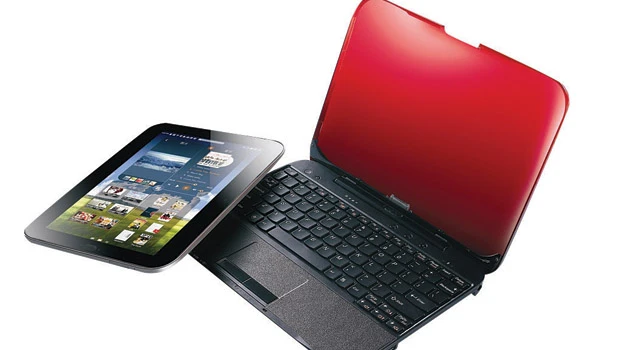
The last bit of hardware to highlight today is one that’s been a year in coming. First unveiled at the 2010 CES, Lenovo’s IdeaPad U1 hybrid with LePad slate, is a two-in-one device that combines the mobility of a high-definition slate featuring access to Android applications along with a keyboard base that provides a full Microsoft Windows 7 Home Premium computing experience. The device allows the user to seamlessly switch between the two different operating systems. The concept behind the U1 hybrid is that consumers can use the light-weight LePad slate when they’re out and about, and then the slate can simply slide into the U1 base running on an Intel CULV processor when there’s a need to create content.
At under two pounds and only half an inch in thickness, LePad is powered by a Qualcomm Snapdragon processor, built on Android 2.2 and offers up to eight hours of battery life. The 10.1-inch widescreen, high-definition LePad slate runs in landscape and portrait modes. Users can consume content such as video, surf the Internet and access social networks from their fingertips, as well as tap out messages and email. It also has a front camera for taking pictures or for video chat, and supports Adobe Flash Player 10.1 for a more complete Web browsing experience. The IdeaPad U1 hybrid becomes available first in China during Q1 2011. The U1 hybrid laptop with LePad slate will retail for $1,300. LePad slate will also be sold alone for $520.