
- BEIRUT: Lebanon’s caretaker prime minister returned home Friday to a deepening political crisis two days after a Hezbollah-led coalition toppled his government.
Saad Hariri has been trying to rally support in the US, France and Turkey since ministers allied to Hezbollah resigned Wednesday, bringing down his government while he was in Washington meeting with President Barack Obama.
Hariri will stay on in a caretaker role while a new government is formed.
The crisis is the climax of long-simmering tensions over the UN tribunal investigating the 2005 assassination of Hariri’s father, former Prime Minister Rafik Hariri.
The tribunal is widely expected to indict members of Hezbollah soon, which many fear could rekindle violence in the tiny nation plagued for decades by war and civil strife. Hezbollah denounces the Netherlands-based tribunal as a conspiracy by the US and Israel and demanded Hariri reject the tribunal’s findings even before they come out.
But Hariri has refused to break cooperation with the court.
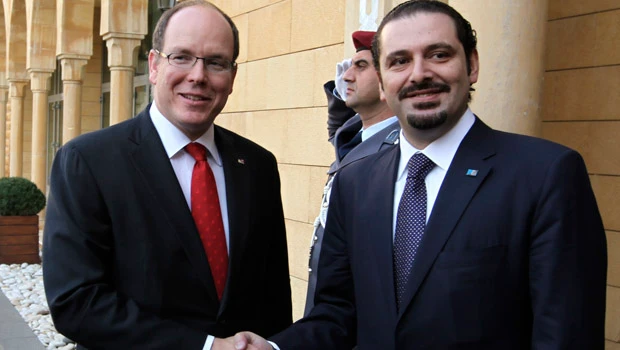
In an effort to ease tensions that some fear could ignite sectarian violence, the US Embassy in Beirut urged all political factions to “remain calm and exercise restraint at this critical time.” Hariri’s office had no immediate comment on his meetings abroad, instead releasing a statement that he had returned to Beirut and was having lunch with Prince Albert II of Monaco.
Turkish Prime Minister Recep Tayyip Erdogan, hours after meeting Hariri, said he would consult authorities in Iran, Syria and Qatar on Friday to try to find a solution to the crisis, the Anatolia news agency reported.
Lengthy negotiations lie ahead between Lebanon’s two main political blocs. If those fail, Lebanon could see a resurgence of the street protests and violence that have bedeviled the country in the past.
President Michel Suleiman will launch formal talks Monday on creating a new government, polling lawmakers on their choice before nominating a prime minister. According to Lebanon’s constitution, the president must be a Christian Maronite, the prime minister a Sunni and the Parliament speaker a Shiite.
Each faith makes up about a third of Lebanon’s population of 4 million.
Oussama Saad, a Sunni politician who is a Hezbollah ally and potential candidate, called for a new prime minister who would “defend the resistance.” “We cannot accept Hariri’s return to the post of prime minister,” he said Friday. “We call for a new prime minister who does not draw strength from the outside against the people of his country, and one who doesn’t conspire against the resistance.” Besides finding a Sunni candidate, Hezbollah would need the backing of Walid Jumblatt, the influential leader of the Druse sect who broke with his former allies in Hariri’s camp in 2009. Jumblatt has been a shrewd politician, known for shifting loyalties.
He met with Hezbollah leader Hassan Nasrallah on Thursday night, but did not comment on the talks.
In the Netherlands, the tribunal was holding a public hearing Friday to discuss a former Lebanese security chief’s demand to see the evidence that led to his being jailed as a suspect for nearly four years.
Maj. Gen. Jamil Al-Sayyed, Lebanon’s former chief of general security, and three other pro-Syrian officers were freed from a Lebanese jail in April 2009 for lack of evidence.
Al-Sayyed claims false witnesses framed him and wants access to their evidence so he can sue them in local courts.