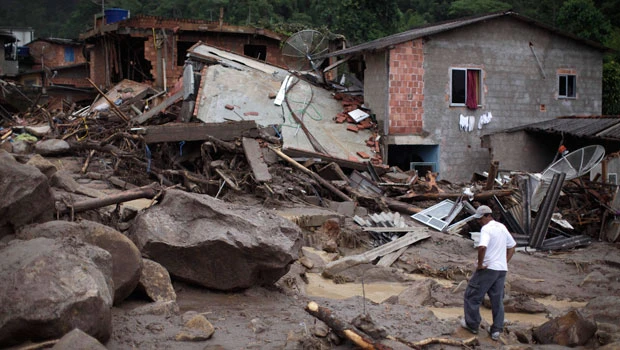
- BRASILIA, Brazil — The death toll in the floods that hit three cities in the Brazilian state of Rio de Janeiro two days ago has hit 524, while continuing rainfall is hampering rescue efforts.
Brazilian President Dilma Rousseff, accompanied by Rio state Gov. Sergio Cabral, overflew the affected area yesterday and immediately authorized the release of R$400 million ($238 million) in emergency federal funds to help the victims.
Governor Cabral admitted at a press conference on Thursday that uncontrolled development of the areas north of the city of Rio de Janeiro, and housing given to poor people in risky areas by politicians, were to blame for this tragedy.
The three main cities that were hit by massive rivers of water, mud, rocks and mud dislodged by swollen rivers were the former Portuguese imperial town of Teresopolis, Petropolis and Nova Fribugo. This mountainous area lies around 100 kilometers north of the city of Rio de Janeiro.
Civil defense helicopters sent to the area were unable to fly on Friday in Teresopolis because of heavy rain, despite the need to rescue people marooned by the floodwaters and debris in remote areas, and to help remove the bodies of victims.
Some 225 men from the National Security Force arrived this morning in the area to help with the search and rescue efforts and to help maintain public order in the streets of the affected cities.
According to the O Globo newspaper, the floods have affected at least 5,500 families, with 1,200 people left homeless in Teresopolis and 1,300 people evacuated from their homes.
Geologists interviewed on Globo television blamed the devastation wrecked by the flash floods on over-development and the walling-in of several rivers that only helped increase the speed of the water when the floods occurred.
Electricity and phone lines have been cut in all three cities, making rescue efforts at night nearly impossible because of the darkness. Most rescue efforts are called-off at night and resume at the first light of dawn.
Many roads into the mountainous area have been closed due to landslides and a fallen bridge. This has forced rescue teams to set up field hospitals in the affected areas to try and treat the wounded on the spot.
The bursting of a water tank in Nova Friburgo on Friday morning caused widespread panic among the population, who thought that a local dam had burst.
Because of the panic, a large conglomeration of people occurred at the exits of the city, as many people tried to flee what they thought was another flood coming.
“There are two dams in Nova Friburgo, but even if these dams burst the water would not reach the center of the city,” Rio state Vice Governor Luiz Fernando Pezao told the G1 news website.
“It was really lamentable having to face these baseless rumors,” he added. “What we need now is for the weather to improve so that we can get supplies and water to isolated areas.”
Meanwhile, two stores were robbed in Teresopolis on Friday morning, causing panic among other storeowners in the city who promptly closed up for a few hours. But military police were quick to arrive on the scene and reinforcements were sent in to patrol the busiest streets.
Amid calls for donations of cash, food and clothes from Brazilians across the country, the mayor of Teresopolis estimated that it would cost more than R$500 million ($298 million) to rebuild his city. Bank accounts for the victims of the floods have been opened in all the major banks for donations, and the federal government is giving money to those who lost their homes to help them rent new accommodations and buy food.
This is the worst natural disaster to hit Brazil. The number of victims of this tragedy has already surpassed the previous record of 436 people dead in floods in the city of Caraguatatuba in Sao Paulo state in 1967.