
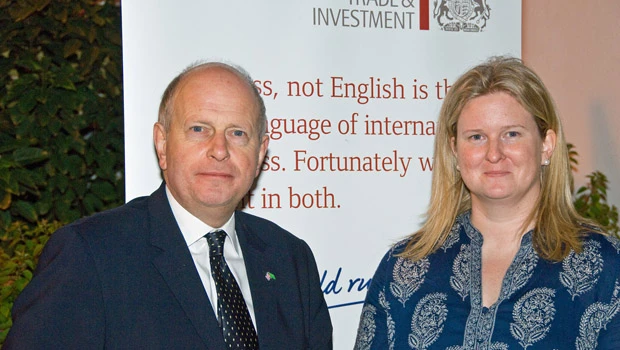
- JEDDAH: A 13-man delegation of major players in the UK water industry arrived Friday in Jeddah to be greeted by winter storms and floods.
The visit, organized by UK Trade and Industry (UKTI), held a presentation and networking evening at the British Consulate on Saturday.
The audience met the representatives of some of the world’s leading water management and engineering companies in what UK Consul General Kate Rudd described as a very productive evening.
The delegation is comprised of companies from international giants such as the $10-billion turnover URS Scott Wilson and Severn Trent Water to highly specialized manufacturers such as Permastore, whose glass-fused-to-steel bolt-together storage tanks are world leaders in economical long-term storage and containment of fluids.
In her opening remarks Rudd summarized the Kingdom’s water landscape. She said that Saudi Arabia was located in one of the most arid areas of the world.
“It is listed under the ‘absolute water scarcity’ category, meaning that Saudi Arabia will not be able to meet its water needs by 2025 due to limited natural resources,” she pointed out.
It was, she added, clear that climate change was taking its toll on the world weather systems.
“It seems that there’s either not enough water, or far too much. We need to be able to capture and store what we need and treat and recycle what we don’t.” Focusing on the aspects of water treatment, Hatim Al-Motairi, director general of the Auditing and Enforcement General Directorate at the Presidency for Meteorology and Environment, quoted the Saudi Basic Law of Governance: “The state shall work toward the preservation, protection and improvement of the environment as well as prevent pollution.” Noting the facts that Jeddah was the most populous city in the world without an integrated wastewater system and that only 22 of the Kingdom’s 106 municipal areas have wastewater networks, Rudd said the growing population is outpacing existing water and sewage treatment plants.
“More investment is needed to build new systems to meet the spiraling demand for drinking water and for sewage treatment,” said Rudd.
Of particular importance to the development of efficient water distribution in the Saudi networks is the suppression of leaks that account for between 30 and 70 percent of transported water loss (depending on the area) within Saudi Arabia.
Tim Hallam of Hyram Ltd. held the attention of the guests with a presentation of highly innovative leak suppression and repair equipment that even allowed “hot tapping” — the connection into a live water main, even under full pressure.
On Sunday morning members of the delegation met Fawaz Bahlas, regional director for Makkah, Jeddah and Taif at the National Water Company’s office in Jeddah.
Further information is available at [email protected].