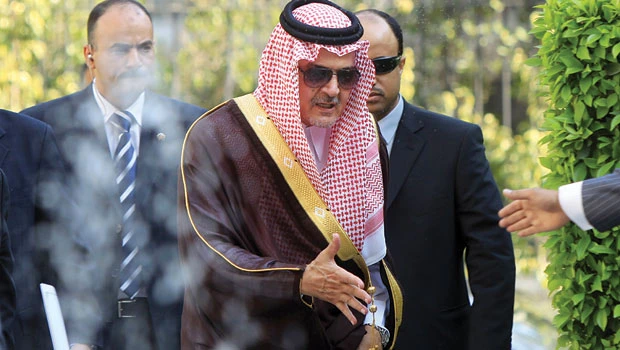
- RIYADH/BEIRUT: Foreign Minister Prince Saud Al-Faisal denied Friday a report carried by Saudi TV that there has been a change in Saudi Arabia's policy toward mediation efforts in Lebanon.
“What has changed is stopping mediation between Syria and Lebanon," the prince was quoted as saying by the Saudi Press Agency. "The Kingdom of Saudi Arabia's stance will continue to support the legitimacy of Lebanon as the basis for the stability, security and safety of Lebanon, stressing the continuation of its policy to support the majority,” the foreign minister said.
The Saudi statement came as Lebanon's Druze leader Walid Jumblatt said his group would support Hezbollah ahead of parliamentary talks on Monday to pick a new prime minister.
With Jumblatt's support it is almost certain Hezbollah and its allies, with 57 seats in Parliament, will win a majority to endorse Sunni politician Omar Karami to lead a new government.
"I am announcing the right political stand ... by assuring the steadfastness of the group (Progressive Socialist Party) alongside Syria and the resistance," he told a news conference. Resistance is a term used to describe Hezbollah.
Hezbollah ministers and their allies resigned from Saad Hariri's Cabinet last week, days before a UN-backed tribunal issued a confidential draft indictment which is expected to accuse Hezbollah members of involvement in the killing of his father.
The group denies any role in the assassination and says the tribunal is serving US and Israeli interests.
Jumblatt described the tribunal as "a tool for destruction.”
Two days of mediation by Qatari and Turkish ministers ended in failure on Thursday and the political deadlock has raised fears of renewed sectarian conflict in Lebanon.
Jumblatt leads a bloc of 11 parliamentarians and his support is crucial to decide who forms the government, Hezbollah or Hariri, who said on Thursday he will seek the premiership.
Once Syria's ally, Jumblatt moved into the anti-Syrian camp after Rafik Hariri's killing, but has since repositioned himself and last year sealed his reconciliation with Syria.
Jumblatt urged all sides to continue dialogue and warned against excluding any party, saying: "It will only lead to more division."
In Lebanon's power-sharing political system, the prime minister should be a Sunni, the president a Maronite Christian and the speaker a Shiite. President Michel Suleiman has called parliamentarians for consultations on Monday.
Hezbollah brought down the fragile unity government of Hariri after mediators failed to reach a deal to contain tensions over the indictment. Hezbollah and its allies accused Washington of sabotaging the mediation efforts by putting pressure on Hariri to stop supporting it. Hariri blamed Hezbollah for the talks' failure.
Jumblatt said all sides had agreed in the talks to cut Lebanon's links to the tribunal, end Lebanon's funding for it and withdraw the Lebanese judges. He said those terms would be confirmed in a policy statement by the new government.
Hezbollah said the act of issuing the indictment on Monday marked a political turning point and no amount of international pressure would force it accept Hariri for another term.
Lebanese officials said the group and its allies will endorse Karami to form the new government.
Karami, a pro-Syrian politician from the northern city of Tripoli, has served as prime minister twice before. He resigned two weeks after Rafik Hariri was killed in February 2005, amid strikes and anti-Syrian protests.
— With input from agencies