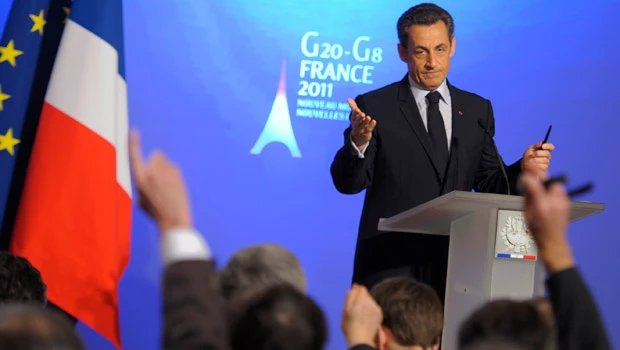
- PARIS: French President Nicolas Sarkozy called in a speech laying out his G20 agenda on Monday for new rules to curb commodity price volatility, warning that the world risks food riots and weaker growth if leaders fail to act.
Speaking to 300 diplomats and journalists in the Elysee presidential palace, Sarkozy also voiced support for a tax on financial transactions, calling such a move a “moral question” but admitting the idea had many enemies.
“How can you explain that we regulate money markets and not commodities?,” said Sarkozy, who holds the rotating presidency of the Group of 20, a policy forum for the world’s leading rich and developing economies, for 2011
“If we don’t do anything we run the risk of food riots in the poorest countries and a very unfavorable effect on global economic growth,” he said. “The day there are food riots, what country at the G20 table will say this does not concern them? I don’t see a single one.”
Sarkozy has a three-pronged agenda for France’s G20 presidency, including tackling volatility in commodity prices, exploring changes to the world monetary system and reforming global economic governance. He has been meeting with fellow G20 leaders, including US President Barack Obama and China’s Hu Jintao, in recent weeks to win support for his plans and assess what France can realistically achieve.
Sarkozy has run into resistance in Washington to his idea to establish a new Bretton Woods system, the monetary order set up on the ashes of World War II which relies heavily on the US dollar.
On a visit to the White House earlier this month, he was at pains to stress to Obama that his currency plans would not put the dollar’s role at risk — a message he reiterated on Monday.
“We want to reassure our American friends that the dollar will remain a pre-eminent currency. But a pre-eminent currency does not mean the sole currency. We have the right to reflect on other approaches.”
Sarkozy also went out of his way to reassure China that he would not join Washington in pressing Beijing to allow its yuan currency to appreciate, saying: “China is a major nation, far be it from me to tell them what to do about their currency.” The third plank of Sarkozy’s G20 agenda — creating a permanent institutional framework for the G20, parallel to the International Monetary Fund (IMF) and World Bank — also faces robust resistance.
As a result, he has shifted the focus of his G20 presidency to commodities — a theme that is also seen as a potential vote winner in next year’s French presidential election. Sarkozy’s popularity is hovering near record lows at around 30 percent and he desperately needs G20 successes to convince a skeptical electorate that he deserves another five-year term.