
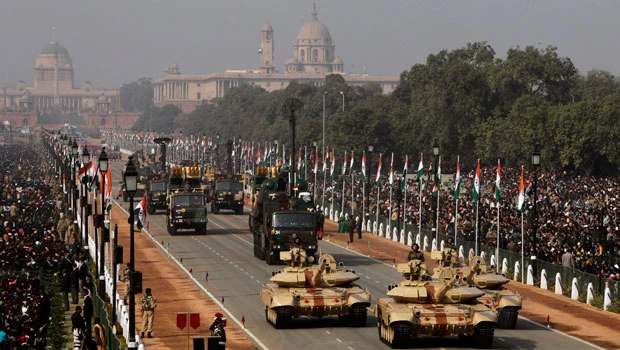
- NEW DELHI: India celebrated its 62nd Republic Day with a grand parade of its military might and cultural diversity in the heart of the capital, with big and small events also held across the length and breadth of the world's largest democracy.
From Kashmir to Kerala and from Gujarat to Assam, tens of thousands turned out to watch the national flag unfurled and parades by police and armed forces as well as children at their colorful best.
There was no major violence anywhere — either in Kashmir. In the northeast, thousands defied militant diktats and took part in official celebrations. The biggest spectacle of all was at the Rajpath boulevard in Delhi where the country's who's who assembled to watch an immaculate 100-minute parade that displayed India's military prowess and cultural heritage.
Watched by thousands on the streets and millions on television, the parade wound its way over eight kilometers from the Raisina Hills, with the imposing presidential palace as its backdrop, to the 17th century Red Fort.
Among those who enjoyed the sights and sounds with visible delight was President Susilo Bambang Yudhoyono, the second Indonesian chief guest at the event after Sukarno in 1950, when India unveiled its constitution. As a bright sun lit up the city, the country's cultural and religious diversity was represented by folk artists and dancers on colorful tableaus. Many won applause from Yudoyono and his wife Ani.
President Pratibha Patil, commander in chief of the armed forces, took salute as military and paramilitary contingents, including mounted troops from the 61st Cavalry and mechanized columns, marched down.
Martial music filled the air with well-known tunes. Many a heart swelled with pride as soldiers drawn from some of the finest military units and paramilitary personnel marched with clockwork precision, matching hand to hand, feet to feet. The Border Security Force camel contingent evoked loud cheers.
The event displayed indigenous military hardware. Taking centerstage and vying for attention were the Light Combat Aircraft Tejas, T-90 main battle tank Bheeshma and BrahMos supersonic cruise missile.
The parade is also known for showcasing the unity in diversity that India has been famous for down the centuries. And sure enough, the tableaux from various parts of India were proof of that.
Yudhoyono, president of the world's most populous Muslim nation, watched with fascination as Karnataka and Bihar showcased India's rich Islamic heritage.
The country's Buddhist roots came alive on the Gujarat tableau. The common man was just as delighted.
Ramadhar Yadav, 72, who had come from Rajasthan, said on Rajpath: “My whole life I was waiting to see this event. It feels great and I hope some day my entire family gets to see it right here.”
The Kashmir tableau showcased the valley's dying folk culture.
The Central Public Works Department float had giant flower sculptures of two tigers with two cubs, underlining the threat to the national animal. Two floats showcased Rabindranath Tagore, the poet-philosopher who won the Nobel Prize.
Schoolchildren put up colorful dances. Daredevil bikers from the Corps of Signals displayed breath-taking formations on motorcycles, leaving Indian and foreign spectators spellbound.
The parade ended with a spectacular fly past by the air force, with 28 aircraft and helicopters setting the capital's skies ablaze.
Before the parade began, Prime Minister Manmohan Singh paid tribute to the unknown soldier at the Amar Jawan Jyoti memorial at India Gate.
Across the capital, security was tight, with police and paramilitary personnel checking motorists. Helicopters hovered in the sky at the parade venue while sharpshooters were deployed on buildings near Rajpath.

