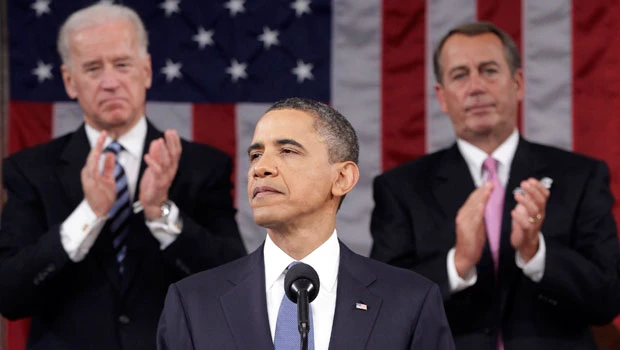
- WASHINGTON: Republicans and Democrats reached across the aisle Tuesday night to sit with one another at President Obama’s State of the Union address.
The president acknowledged the unusual show of unity but cautioned: “What comes of this moment will be determined not by whether we can sit together tonight, but whether we can work together tomorrow.”
His one-hour speech was optimistic, almost nationalistic, saying the United States has always risen to challenges, and he used the prime-time state to combine a number of policy proposals into a blueprint for confronting growing threats to US economic dominance.
“Yes, the world has changed,” he said. “The competition for jobs is real. But this shouldn’t discourage us. It should challenge us. Remember, for all the hits we’ve taken these last few years, for all the naysayers predicting our decline, America still has the largest, most prosperous economy in the world.”
Obama called for five-year freeze in domestic spending, except for “investments” in education reform, infrastructure and research. Obama also introduced plans for increased access to high speed technology and touched on ideas with bipartisan appeal, from medical malpractice reform to deficit reduction.
He also promised to veto any bill that arrives on his desk with pet projects destined for lawmakers’ districts, known as ‘earmarks’.”
More than halfway in to his address, Obama spoke about foreign policy, the Iraq war and Afghanistan.
The president used his address before Congress as a method to show his support for the American Muslim community.
“And as extremists try to inspire acts of violence within our borders, we are responding with the strength of our communities, with respect for the rule of law, and with the conviction that American Muslims are a part of our American family.”
“At a time when American Muslims face the prospect of agenda-driven hearings in Congress targeting their community, we welcome President Obama’s decision to emphasize the fact that Muslims are contributing members of our society,” said CAIR National Executive Director Nihad Awad. “It was a timely and important reminder to our nation’s leaders and the viewing audience that America’s strength and security lie in the unity of its people.”
And after weeks of unrest in Tunisia, Obama said “the will of the people proved more powerful that the writ of a dictator” in the North African country, where recent demonstrations against economic inequality, official corruption and political oppression drove the autocratic President Zine el-Abidine Ben Ali into exile after 23 years in power.
“The United States of American stands with the people of Tunisia and supports the democratic aspirations of all people,” Obama said.
He also announced plans to make his first-ever trip to South America, traveling to Brazil, Chile and El Salvador in March.
The president called on Congress to pass a mandate that includes both traditional renewable energy sources like wind and solar, including the Republican favorites of nuclear and “clean coal” that may be needed to push through the most aggressive and politically feasible means of reducing greenhouse gas emissions on Capitol Hill this Congress.
Obama set a new goal in his speech Tuesday night, calling for 80 percent of US electricity to stem from “clean energy” sources by 2035. “Some folks want wind and solar. Others want nuclear, clean coal, and natural gas,” Obama said. “To meet this goal, we will need them all – and I urge Democrats and Republicans to work together to make it happen.”
The public is feeling more optimistic about the economy and voters are giving Obama credit for reaching out to Republicans in a bipartisan way, and the president won high marks for his speech in Tucson after the shooting there three weeks ago. But he did not call for new gun legislation, as some expected he might in wake of the deadly shootings.
Obama headed into the speech in surprisingly good political shape; given the drubbing Democrats took in the November mid-term elections. Hi job approval ratings are up – in some polls, higher than 50 percent.
Although he has gained ground among independent voters, who remain key to the outcome of the 2012 elections, they are still up for grabs depending on whether the economy recovers and who wins the coming debate about spending cuts and restraining government growth.
A CBS News poll conducted just after the speech found 91 percent approved of the president’s performance.
Obama used the speech to emphasize bipartisan consensus issues, some of which are Jewish community priorities, too. He outlined a plan to boost education, including preparing 100,000 new teachers of science and technology and making a $10,000 tuition tax credit permanent. He called for 80 percent of electricity to be powered by “clean energy” by 2035 and for a million electric vehicles to be on the roads by 2015.