
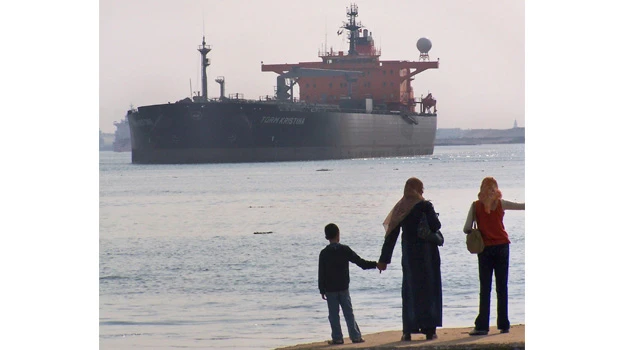
- LONDON: No direct threat to ships passing through the strategic Suez Canal waterway exists at the moment, despite unrest in Egypt, a senior official with London's marine insurance market said on Monday.
More than 100 people have been killed in seven days of protests aimed at ending Egyptian President Hosni Mubarak's 30-year-old rule. The uprising has rattled global investors.
"We are not seeing anything that would give us any particular cause for concern at this stage," said Neil Roberts, a senior technical executive with the Lloyd's Market Association.
The 192-km (120-mile) canal is the key passageway for Europe's crude oil and imported goods. Egypt earned nearly $5 billion last year in receipts from shipping traffic.
"There is no direct to threat to ships that we can see and it would be counter intuitive for the Egyptians to do anything with Suez that would stop their flow of trade," said Roberts, whose association represents the interests of all underwriting businesses in the Lloyd's market. Roberts said he was not aware of any rise in insurance premiums on ships traveling via Suez. "It's speculation," he told Reuters. "I doubt there is any substance to that as a suggestion." A senior canal official said the waterway, which is the quickest sea route between Asia and Europe, was working as normal on Monday. The city of Suez has been the scene of some of the most violent protests in recent days.
"The Egyptian military has bolstered its presence around the critical waterway and in the event of further unrest it will remain a major priority for army protection," security firm AKE said. Shipping agents said they were unable to board vessels during the curfew time, which had been imposed across Egypt.
Crude oil and refined products volume accounted for around 15 percent of Suez cargoes in 2009, with over 50 percent of transits made by container ships transporting finished goods from electronics to toys.
"It is very easy to see that the political situation is unstable and there could certainly be damage from riots. That is something that cargo underwriters will bear in mind but they can't react in the short-term," Roberts said.
DP World Limited, the world's third largest ports operator said it had temporarily suspended its Egypt port terminal operations as a precautionary measure. Danish shipping and oil
group A.P. Moller-Maersk said it had also suspended its port terminal operations and closed its shipping offices.
"Even if Western companies become a major target for the protesters, we believe that shipping traffic through the canal is unlikely to be seriously imperiled, though some individual ships docked in port might be at risk of attack if the situation deteriorates further," Barclays Capital said in a note.