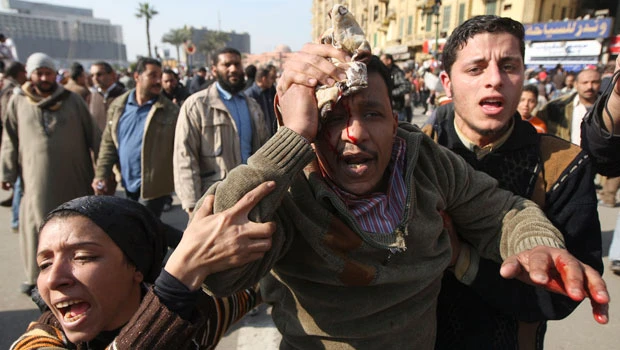
- CAIRO: Opponents and supporters of President Hosni Mubarak fought with fists, stones and clubs in Cairo on Wednesday in what appeared to be a move by forces loyal to the Egyptian leader to end protests calling for him to quit.
Protesters said some of the Mubarak supporters were members of the hated police force in plain clothes. Some rode into the crowd on horses and camels and in carriages, wielding whips and sticks.
People fought while troops surrounding the vast Tahrir (Liberation) Square made no attempt to intervene. Reuters correspondents saw dozens of injured. Many people fled in panic.
Anti-Mubarak protesters said they would not leave the square until Mubarak quits.
Khalil, a man in his 60s holding a stick, blamed Mubarak supporters and undercover security men for the clashes.
“But we will not leave,” he told Reuters. “Everybody stay put.”
The Interior Ministry denied police were involved.
The fighting broke out as international pressure grew on Mubarak to quit and his closest ally, the United States, told him bluntly that a political transition must begin immediately.
After Mubarak went on national television on Tuesday night to say he would not stand in elections scheduled for September, the armed forces said the protesters’ demands had been heard and it was time for them to clear the streets.
Soon after several hundred pro-Mubarak supporters entered Tahrir (Liberation) Square, where a few thousand protesters had gathered, and the clashes broke out, witnesses said.
Opposition figurehead Mohammed ElBaradei, a Nobel Peace laureate, accused the government of using “scare tactics.”
“This is yet another symptom, or another indication, of a criminal regime using criminal acts,” ElBaradei told the BBC.
It was the ninth day of protests that broke out last week as public frustration with corruption, oppression and economic hardship under 30 years of rule by Mubarak boiled over.
An opposition coalition, which includes Islamist organization the Muslim Brotherhood, responded to the army warning by calling for more protests.
It said it would only negotiate with Vice President Omar Suleiman, a former intelligence chief appointed by Mubarak at the weekend, once Mubarak stepped down.
Mubarak’s offer to leave in September was his latest gambit in the crisis. At the weekend he reshuffled his cabinet and promised reform but it was not enough for protesters.
One million people took to the streets of Egyptian cities on Tuesday calling for him to quit.
Wednesday’s violence was the worst in the crisis since Friday, when police and protesters fought running street battles. At least 140 people are estimated to have been killed so far.
International backing for Mubarak, for three decades a stalwart of the West’s Middle East policy and styled as a bulwark against the spread of militant Islam, has crumbled as he tried to brazen out the crisis.
US President Barack Obama spoke to Mubarak for half an hour by telephone on Tuesday night after the 82-year-old announced his plan to step down in September.
“What is clear and what I indicated tonight to President Mubarak is my belief that an orderly transition must be meaningful, it must be peaceful and it must begin now,” Obama said after speaking to him.
Pressure also came from Turkey, an important diplomatic voice in the Muslim world. Prime Minister Tayyip Erdogan said Mubarak’s plan to step down in seven months time did not meet the people’s expectations and the change should begin sooner.
France, Germany and Britain also called for a speedy transition.
“The transition needs to be rapid and credible and it needs to start now,” British Prime Minister David Cameron told the UK parliament.
Israel, which signed a peace treaty with Egypt in 1979, is also watching the situation in its western neighbor nervously, weighing the possibility that anti-Israeli Islamists might gain a share of power.
Many analysts see the army as trying to ensure a transition of power that would allow it to retain much of its influence.
Hani Sabra, a Eurasia Group analyst, said Mubarak’s announcement he would stand in the election in September marked the start a long, messy negotiation process between the government and the opposition.
“In the medium term, these negotiations will likely produce an Egypt best described as a hybrid democracy, combining a strong military with a more pluralistic electoral system,” he said.
“Mubarak’s speech was formulated to superficially display his resolve. Mubarak also declared that he would die in Egypt, a direct reference to protesters who have demanded his departure.”
The uprising was inspired in part by a popular revolt in Tunisia last month which overthrew long-ruling President Zine Al-Abidine Ben Ali. The mood is spreading across the region.
King Abdallah of Jordan replaced his prime minister on Tuesday after protests there.
Yemeni President Ali Abdullah Saleh, a key US ally in the fight against Al-Qaeda, said on Wednesday he would not seek to extend his presidency, a move that would end his three-decade rule in 2013.
Oil prices fell back from 28-month highs, but North Sea Brent crude was still more than $101 a barrel on worries that unrest in Egypt could trigger regime change across the Middle East and North Africa.
But with Mubarak pledging to go, foreign investors have begun to show renewed interest in Egyptian bonds and stocks and the cost of insuring Egyptian debt against default fell.