- • Hundreds injured as rival groups fight pitched battles • Govt accused of dispatching thugs; 30 of them thrashed • ‘Going rate to join Mubarak rally is 100 Egyptian pounds’ • Mubarak’s pledge not to seek a 6th term has few takers • Google executive in Egypt has been missing for a week
CAIRO: Chaos consumed Cairo's Tahrir Square on Wednesday as thousands of supporters and opponents of President Hosni Mubarak battled in Cairo’s main square, raining stones, bottles and firebombs on one another as soldiers stood by without intervening.
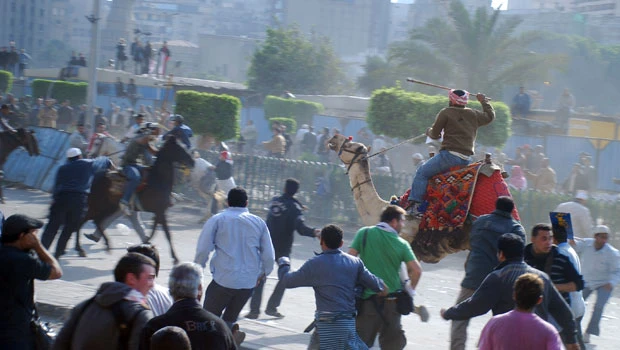
Government backers galloped in on horses and camels, only to be dragged to the ground and beaten bloody. At one of the fighting’s front lines, next to the famed Egyptian Museum at the edge of Tahrir Square, pro-government rioters blanketed the rooftops of nearby buildings and dumped bricks and firebombs onto the crowd below — in the process setting a tree ablaze inside the museum grounds. Egypt’s Health Ministry said 611 people had been wounded in the clashes. State TV said a member of the security forces had been killed
Government backers dropped concrete blocks onto the crowd from above, and tear gas was fired at anti-government opponents. Anti-government demonstrators accused Mubarak and his government of dispatching “thugs” to attack them, after hundreds of pro-regime partisans marched into the central square around 3 p.m. (1300 GMT).
Groups of government opponents meanwhile plucked at least 30 Mubarak supporters one-by-one from the crowd, and beat them up before handing them over to soldiers, a reporter said.
Opposition leader Mohamed El-Baradei accused the government of “scare tactics.” “I'm extremely concerned, I mean this is yet another symptom, or another indication, of a criminal regime using criminal acts,” El-Baradei said.
“My fear is that it will turn into a bloodbath,” he added.
In the upmarket Mohandeseen district, an estimated 3,000 people rallied in support of Mubarak, chanting “We don't want you to go,” and accusing El-Baradei of being a traitor.
A witness said organizers were paying people 100 Egyptian pounds (12 euros, $17) to take part in the pro-Mubarak rally.
The clashes marked a dangerous new phase in Egypt's upheaval — the first significant violence between supporters of the two camps in more than a week of anti-government protests. Clashes began, first in the port city of Alexandria, just hours after Mubarak went on national television late Tuesday night and rejected protesters' demands he step down immediately. He defiantly insisted he would serve out the remaining seven months of his term.
International concern was also mounting. The White House deplored the violence and called for restraint.
British Prime Minister David Cameron said Egyptian authorities must accelerate their political reforms and said that “if it turns out that the regime in any way has been sponsoring or tolerating this violence, that would be completely and utterly unacceptable.”
German Fore-ign Minister Guido Wester-welle said the violence “raises the urgent question whether the political leaders of Egypt understand the need for rapid democratic reform.”
Gatherings of Mubarak supporters were more hostile to journalists and foreigners. Two AP correspondents and several other journalists were roughed up during various such gatherings. State TV reported Tuesday night that foreigners were caught distributing anti-Mubarak leaflets, apparently trying to depict the movement as foreign-fueled.
As if to show the public the crisis was ending, the government began to reinstate Internet service after days of an unprecedented cutoff. State TV announced the easing of a nighttime curfew, which now runs from 5 p.m. to 7 a.m. instead of 3 p.m. to 8 a.m.
In his 10-minute pre-recorded speech, Mubarak emphasized the theme that he has often used in justifying his rule during his nearly three decades in power — that he can keep stability. Now he was promising to do so as he heads out the door. The president insisted that even if the protests demanding his ouster had not broken out, he would not have sought a sixth term in September.
Somber but firm — without an air of defeat — he said he would serve out the rest of his term working “to accomplish the necessary steps for the peaceful transfer of power.” He said he would carry out amendments to rules on presidential elections. Soon after Mubarak's address, President Barack Obama said that he had spoken with Mubarak and “he recognizes that the status quo is not sustainable and a change must take place.”
Egypt's Foreign Ministry, meanwhile, said on Wednesday it rejected the US and European calls for the process of political transition in Egypt to start now. The ministry statement, carried by the official news agency MENA, said calls from “foreign parties” talking about a transition now were “rejected and aimed to incite the internal situation in Egypt.”
Meanwhile, Google, the US Internet search giant, is asking for the public’s help in locating one of its executives who has been missing in Egypt after protests began to grip the country. Wael Ghonim, Google’s head of marketing for Middle East and North Africa, hasn’t been heard from since last Thursday night, friends and family told media outlets. Ghonim had arrived in Cairo earlier last week for a conference.