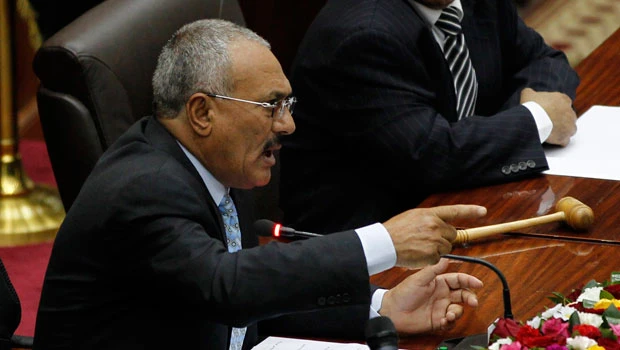
- SANAA: Bowing to the opposition’s demands, Yemen’s President Ali Abdullah Saleh told Parliament on Wednesday he would neither seek another term in office in the 2013 elections nor hand power to his son.
“No to hereditary rule and no to life presidency,” he said addressing a joint meeting of Parliament and the Shoura Council in Sanaa.
Saleh, who has been in power for nearly 32 years, spoke to lawmakers in both houses of the assembly on the eve of mass rallies the opposition called for Thursday in all Yemeni provinces.
Facing mounting opposition calling for his ouster, Saleh froze constitutional amendments — a bone of contention between the ruling party and the opposition.
Saleh postponed the April 27 parliamentary elections, which the opposition threatened to boycott.
“As a president of this country, I will not stick to my guns, whatever the circumstances,” he said. “I will make concessions and compromises for the sake of this nation which is above our own interests.”
Saleh also announced a raft of reforms. “We will introduce comprehensive reforms in local government, and governors and district directors will be elected directly by the people,” he said. “I will give wide powers to the governors. We want to pull the rug from under the advocates of federalism and the unity renegades (secessionists). We will expand the social security network and will open the door for underwriting in the domains of cement, telecommunication, oil and banks.”
Saleh called the opposition to stop rallies and return to dialogue.
His announcement comes ahead of the opposition's mobilization for a massive demonstration across the country on a so-called “Day of Rage.”
Prior to the call of the president, the Joint Meeting Parties bloc in Parliament announced that it would boycott his meeting.
The Ministry of Interior on Wednesday instructed the security units surrounding Sanaa to be on heightened alert ahead of demonstrations. Police were ordered to intensify scanning people for weapons and look out for those on the most-wanted list. Drivers won't be allowed to enter the capital through unpaved or secondary roads.
On Tuesday night Saleh ordered the release of Abdul Elah Haidar, a Yemeni journalist and Al-Qaeda expert who was sentenced in January to five years in prison for allegedly participating in an armed illegal gang and abetting Al-Qaeda.
According to The Associated Press, Saleh had earlier tried to defuse simmering tensions by raising salaries for the army and by denying opponents' claims he plans to install his son as his successor.
Opposition spokesman Mohammed Al-Sabri rejected the call for dialogue and expressed doubts about Saleh's pledge not to seek reelection. Al-Sabri said Saleh made a similar promise in 2006, but then failed to fulfill it, ran again and was re-elected.
“The calls for dialogue are not serious and are merely meant to be tranquilizers,” Al-Sabri told The Associated Press.
Facing growing protests among Yemenis since last month's downfall of Tunisia's president and the continuing mass protests in Egypt, Saleh urged the government to provide Yemen's unemployed with jobs, said an AFP report.