
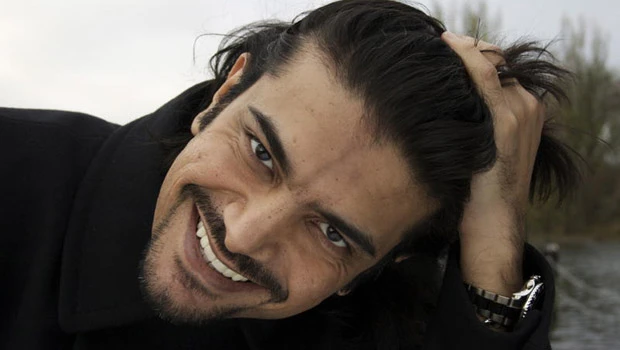
- Saad Bin Mohammed, is a Saudi writer and evolving artist who is straightforward, assertive and outspoken.
- One may call him a man of many words, but in his latest painting, “A Witness Who Never Forgot,” he preferred to speak through silence.
Arab News caught up with the artist whose mixed media artwork was recently displayed at the Young Saudi Artists exhibition at Athr gallery in Jeddah.
Not that I’m his greatest admirer, but Picasso once said: “I paint what I think and not what I see.”
I’m a writer, so I paint what I feel inside. Whatever I do, it is about self-discovery — just like my writings. I am my own model, so my paintings mirror my own thoughts and feelings. I keep doing that even in my books. I have been painting for 20 years now but kept my work to myself. I only recently started showcasing them after persuasion from my friends who believed in me.
Of course, entirely! “The Witness Who Never Forgot” is also symbolic of those people who were there with me and witnessed the Jeddah flood events in 2009. When my friends who were trying to help people recuperate from the disaster saw my painting, they said they saw themselves in it. It’s a pain that will never go away. Jeddah is not just a city to us; it’s our roots and our home, regardless of what kind of a house one may live in. The whole city is our home. This was a very emotional piece of work for me; there have literally been tears in it!
It must have taken me about 10 days to complete. I started it almost a year after the incident and completed it three weeks ago. The pain is still there; it has remained. Maybe I am criticizing the silence of the painting, but it’s screaming out loud. It doesn’t matter if you don’t want to talk about the situation, just don’t forget about it. Knowing the problem is half of the solution.
I wanted to highlight the locality of the misery that took place. I am talking about Saudis, particularly Jeddawis. This should push us to do something regardless of what it is, but most importantly, we should not forget.
Usually, when a shemagh is worn, it is meant to fall over the back, expressing the security an individual feels. In my painting, however, I intended to make it blow away with the wind, exposing the back, which in fact alludes to the insecurity of being in Jeddah.
I love my city, but I’m insecure. The subject in my painting is seen merging with the water to represent the oneness of the individual with the disaster. You can’t separate the two.
How has the reception been toward your work?
Beyond my expectations! It’s always very subjective. People may love your work or hate it.
Unbelievably promising! On the very first day, 80 percent of the artwork at the Young Saudi Artists exhibition was sold out. I want to play the role of a supportive father here to emerging young artists since the future is very promising. For instance, an Armenian art collector bought the artwork of Nasser Al-Salim at first sight. It wasn’t bought because Al-Salim was Saudi or even Muslim, but because his artwork was truly appreciated. This shows that there are no borders when one appreciates art.