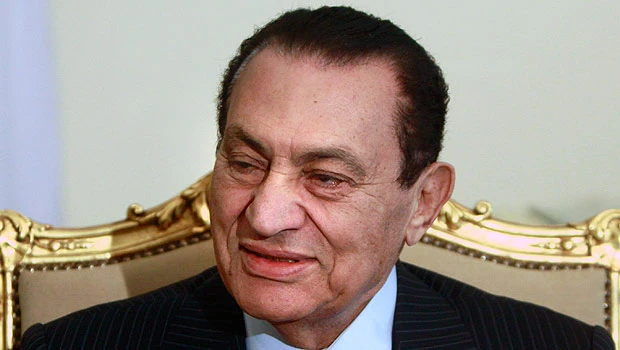
- CAIRO: Egyptian President Hosni Mubarak announced Thursday he is handing some of his powers over to his vice president, Omar Suleiman, but will remain president until elections in September.
"I have seen that it is required to delegate the powers and authorities of the president to the vice president as dictated in the constitution," Mubarak said near the end of his 15-minute address. The article is used to transfer powers if the president is "temporarily" unable to carry out his duties and does not mean his resignation.
Mubarak said that the demands of protesters are just and legitimate. He said he had requested six constitutional amendments to answer protesters' reform demands and that he would lift hated emergency laws — but with the caveat, when security permitted.
The president said he would stay in the country and that he is "adamant to continue to shoulder my responsibility to protect the constitution and safeguard the interests of the people ... until power is handed over to those elected in September by the people in free and fair elections in which all the guarantees of transparencies will be secured." He also said perpetrators of violence during the protests would be severely punished.
Protesters in Cairo's central Tahrir Square, hoping he would announce his resignation outright, reacted to Mubarak's televised speech in stunned disbelief. There were shouts of "Irhil, Irhil (go away, go away). After the speech the crowds started chanting "revolution until victory."
Some in the crowd called for an immediate general strike and demanded of the army, which had deployed large numbers of troops and tanks around the protest: "Egyptian Army, the choice is now, the regime or the people!"
Earlier, the square had been bathed in a carnival atmosphere, as many tens of thousands of Egyptians gathered to celebrate what they hoped would be Mubarak's final speech of a three-decade-long rule.
Supermarket worker 30-year-old Rahman Gamal said: "Omar Suleiman and Mubarak are the same. They are two faces of the same coin. Our first demand is that he leave, if he doesn't leave I won't leave."
US President Barack Obama said Washington stood ready "to support an orderly and genuine transition to democracy" in Egypt. "What is absolutely clear is we are witnessing history unfold," Obama told students at Northern Michigan University. "It's a moment of transformation," he said.
"The people of Egypt are calling for change, they've turned out in extraordinary numbers and all ages and all walks of life," Obama said. He said it was young people "who've been at the forefront" of the demand for change.
Saudi Foreign Minister Prince Saud Al-Faisal condemned interference by some countries in Egypt's affairs during the unrest. “We express our strong condemnation and disapproval at the intervention of some foreign countries in the internal affairs of Egypt, pushing the people to extremes. It is incompatible with the simplest diplomatic and political regulations and the charter of the United Nations, which clearly stipulates in its first article to respect the sovereignty and independence of states and not to interfere in the internal affairs of a country,” Prince Saud said while addressing a ministerial level meeting of the Saudi-Morocco Committee for Bilateral Cooperation in Rabat .
The prince expressed his confidence that Egypt would successfully pass its period of trial and solve its issues peacefully.
As Saudia Flight SV301 landed in Cairo earlier in the evening, a passenger got a message on his cell phone that Mubarak may step down.
The recipient of the message had a broad smile on his face. As the news spread, the number of smiling faces increased. The queuing passengers at the immigration counters also passed the message to each other.
In the almost deserted airport, the silence was punctured by the wailing of zaghroota (an Egyptian sound made during happy occasions).
It was an emotional scene and some women were crying.
Some of the passengers at the luggage carousel received word that the number of people at Tahrir Square and adjoining areas reached 3 million.
On the streets, it was like an Eid night. Crowds of people, including whole families with children, moved on the bridge toward Tahrir Square. A lone tank blocked the Kasr El-Nile bridge, allowing only pedestrians to reach Tahrir Square. Some young people told Arab News they were going to sleep in and around the square so they would be ready for the morrow.
Bus drivers and public transport workers in Cairo earlier joined thousands of state employees on strike in spreading labor unrest that pumped further strength and momentum into the wave of anti-government protests.
Hundreds of doctors in white coats marched down a street from the Qasr El-Aini hospital to Tahrir Square. From another direction, crowds of lawyers in black robes marched from their union to the square, waving Egyptian flags.
Hours before Mubarak's announcement, a left-wing opposition party formerly known for toeing his line, announced it was withdrawing from a national dialogue on reform.
The Tagammu party, which controls a handful of seats in Parliament, said in a faxed statement its decision was based on "the regime's refusal to address the minimum of the people's demands."
It also objected to a comment by Vice President Omar Suleiman, who warned this week that the alternative to talks with the opposition would be a coup.
Tagammu, headed by senate member Rifaat Al-Said, refused to join other parties in a boycott of November's contested parliamentary election. Said told Agence France Presse the party no longer believed there was any use in talking with the government. "We used to. But we reached a bottleneck, and the government keeps giving promises without delivering."