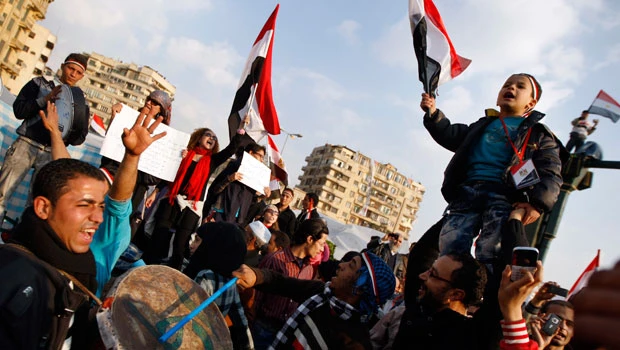
- CAIRO: Fireworks burst over Tahrir Square and Egypt exploded with joy and tears of relief after pro-democracy protesters brought down President Hosni Mubarak with a momentous march on his palaces and state TV.
- Mubarak, who until the end seemed unable to grasp the depth of resentment over his three decades of rule, finally resigned Friday and handed power to the military.
The crowds in Cairo, the Mediterranean city of Alexandria and other cities around the country erupted into a pandemonium of cheers and waving flags. They danced, hugged and raised their hands in prayer after Vice President Omar Suleiman made the announcement on national TV just after nightfall.
Up to the last hours, Mubarak sought to cling to power, handing some of his authorities to Suleiman while keeping his title. But an explosion of protests Friday rejecting the move appeared to have pushed the military into forcing him out completely. Hundreds of thousands marched throughout the day in cities across the country as soldiers stood by, besieging his palaces in Cairo and Alexandria and the state TV building. A governor of a southern province was forced to flee to safety in the face of protests there.
Mubarak himself flew to his isolated palace in the Red Sea resort of Sharm El-Sheikh, 400 km from the turmoil in Cairo. His fall came 32 years to the day after the collapse of the shah’s government in Iran.
The Swiss government ordered a freeze on any assets belonging to Mubarak and his entourage shortly after his ouster. A Foreign Ministry statement said the three-year freeze was aimed at preventing any risk of embezzlement of Egyptian state property.
Apart from any cash or investments in Swiss bank accounts, the order also applies to the sale or transfer of any residential or commercial property.
Egypt is now ruled by the Armed Forces Supreme Council, the military’s top body consisting of its highest ranking generals and headed by Defense Minister Field Marshal Hussein Tanwawi.
After Mubarak’s resignation, a military spokesman appeared on state TV and promised the army would not act as a substitute for a government based on the “legitimacy of the people.” He said the military was preparing the next steps needed “to acheive the ambitions of our great nation” and would announce them soon. He praised Mubarak for his contributions to the country, then expressed the military’s condolences for protesters killed in the unrest, standing at attention to give a salute.
Earlier in the day, the council vowed to guide the country to greater democracy. It said was committed “to shepherding the legitimate demands of the people and endeavoring to their implementation within a defined timetable until a peaceful transition to a democratic society aspired to by the people.”
Abdel-Rahman Samir, one of the protest organizers, said the movement would now open negotiations with the military over democratic reforms but vowed protests would continue to ensure change is carried out.
“We still don’t have any guarantees yet — if we end the whole situation now it’s like we haven’t done anything,” he said. “So we need to keep sitting in Tahrir until we get all our demands.”
President Barack Obama said Mubarak's resignation is the beginning, not the end, of the transition to democracy in Egypt. Speaking just hours after Mubarak relinquished the presidency, Obama said the longtime Egyptian leader responded to his people's hunger for change. But he warned that there will still be difficult days ahead for Egypt as it works toward free and fair elections.
“It is a historic day for the people of Egypt,” declared Vice President Joe Biden during an appearance in the state of Kentucky.
Israel watched Mubarak’s resignation with trepidation, concerned the ouster of its staunchest Arab ally might endanger a peace treaty between the two countries. Israel’s government declined comment. However, former Israeli officials expressed concern that regime change in Egypt, as part of a wider transformation of the Arab world, could leave Israel even more isolated.
Salil Shetty, Amnesty International’s secretary-general, said the departure of one man is not the end. The repressive system that Egyptians have suffered for three decades has not gone away and the State of Emergency remains in place. "Those in power must grasp this opportunity to consign the systematic abuses of the past to history. Human rights reform must begin now," he said.