- CAIRO: Egyptians woke to a new dawn on Saturday after 30 years of autocratic rule under Hosni Mubarak, full of hope after achieving almost unthinkable change.
- But with the army in charge and an uncertain future ahead, many protesters vowed to stay camped in a Cairo's famous Tahrir Square until they hear “clear assurances” that their demands for democracy will be met.
As the muezzin’s call to prayer reverberated across a misty Cairo, the sound of car horns honking in jubilation grew louder after a night when millions throughout the Arab world’s most populous country joyfully celebrated the fall of the president.
“The Revolution of the Youths forced Mubarak to leave,” said a front-page headline in the state-owned Al-Ahram newspaper. “The Jan. 25 Revolution won. Mubarak steps out and the army rules,” said Al-Gomhuria, another state-run daily.
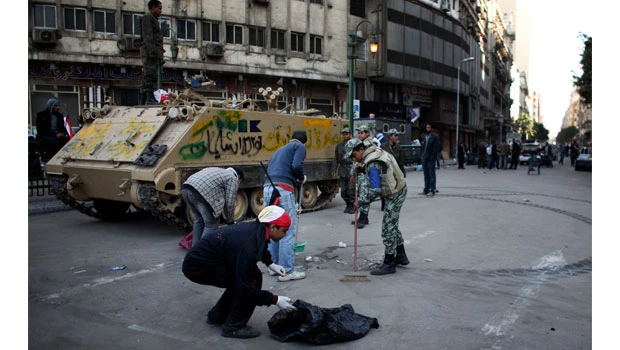
Burnt-out vehicles were being towed away and soldiers swept the streets and cleared barricades to open at least road leading to Tahrir, or Liberation, Square after a night of jubilant celebration and nearly three weeks of protests that forced President Hosni Mubarak to surrender power to the military.
Protesters were divided. Some took down their makeshift tents and headed home. Others vowed to stay put until the military, which has pledged to shepherd reforms for greater democracy, issues a promised statement on its next steps.
Those could include the dissolving of parliament and creation of a transitional government.
“We have to see how the army will orchestrate a democratic transfer of power. We have to wait and see,” said Ali Mohammed, a sales manager camped out on the square.
Under a banner reading “the people managed to oust the regime,” two other protesters argued about whether to clear the downtown square near the famed Egyptian museum.
Shopkeeper Gomaa Abdel-Maqsoud says he’s been in Tahrir Square since the protests began on Jan. 25 and is ready to go. He says “I have never seen such happiness in peoples’ faces before; what else do I want?” he asked.
Nadal Saqr, a university professor, insisted protesters should stay until the army offers “clear assurances” that their demands for democracy are met.
Elsewhere, Egyptians in coffee houses and on the street scoured newspapers for details about the astonishing events from the day before — when hundreds of thousands marched on Mubarak’s palaces in Cairo and Alexandria and besieged state TV, leading the military to effectively carry out a coup at the please of protesters.
The 82-year-old former leader, meanwhile, remained with his family in the Red Sea resort of Sharm el-Sheikh, according to local officials, who spoke on condition of anonymity because they weren’t authorized to release the information.
Mubarak’s downfall at the hands of the biggest popular uprising in the modern history of the Arab world had stunning implications for the United States and the West, Israel, and the region, unsettling rulers across the Mideast.
It remained to be seen how the military high command would create democracy for the first time in a country that traces its history back to the pharaohs more than 5,000 years ago and that has seen such upheaval in an uprising that took just 18 days.
The first priority was law and order before the start of the working week, which begins on Sunday in Egypt. Army tanks and soldiers stayed on the streets guarding key intersections and government buildings after the disgraced police force melted away.
With the threat of possible confrontation between the army and protesters now gone, Cairo residents took souvenir photographs of each other with smiling soldiers at roadblocks to record the first day of a new post-Mubarak era.
“I could not have imagined living to see such a day ... I just hope the new system in Egypt benefits us and fulfils our dreams,” Essam Ismail, a Cairo resident in his thirties, told Reuters. “I still can’t believe it really happened.”
Mubarak, 82, was believed to be at his residence in the Red Sea resort of Sharm el-Sheikh, his future unclear.
Al Arabiya television said the army would soon dismiss the cabinet and suspend parliament. The head of the Constitutional Court would join the leadership with the military council, which was given the job of running the country of 80 million people.
Despite misgivings about military rule, the best deterrent to any attempt to keep the high command in power could be the street power and energy of protesters nationwide who showed Mubarak they could make Egypt ungovernable without their consent.
As persistent turmoil in Tunisia showed, a month after the overthrow of its autocratic ruler inspired Egyptians to act, the new government would face huge social and economic problems.
A wave of people power roared across this pivotal US ally in the Middle East. Throughout the region and beyond, autocratic rulers were now calculating their chances of survival.
“It’s broken a psychological barrier, not just for North Africa, but across the Middle East. I think you could see some contagion in terms of protests; Morocco, perhaps Jordan, Yemen,” said Anthony Skinner of political risk consultancy Maplecroft.
In Algeria, thousands of police in riot gear poured into the center of the capital on Saturday to try to stop a planned demonstration there from copying the uprising which forced out Egyptian President Hosni Mubarak.
Egypt’s opposition had been stifled by 30 years of emergency rule imposed after Mubarak succeeded Anwar Sadat, killed by an Islamist army officer in 1981, and there was no obvious Nelson Mandela or Lech Walesa leading Egypt’s revolution.
Among possible leaders was Ayman Nour, who challenged Mubarak in the most recent presidential election and was later charged with forgery and jailed for three years.
Arab League Secretary-General Amr Moussa, a former Egyptian foreign minister, has often won Arab public support for his outspoken comments. Moussa said on Friday he would leave the pan-Arab body which he headed for about 10 years within weeks.
There were also some popular members from the Muslim Brotherhood group and other opposition parties. It was still unclear if any of the anonymous youth leaders behind the well-organized revolt wanted or would be allowed to hold office.
Another candidate was Mohamed ElBaradei, a veteran diplomat, Nobel Peace Prize laureate and leading opposition activist, who started a campaign last year asking for democracy and an end to the current regime. Asked on Friday if he was going to run for presidency, he said the issue was not on his mind.
The army dismantled checkpoints on Saturday around Tahrir, or Liberation, Square, which became the epicenter of the protest movement, and some makeshift barricades were being removed.
Eighteen days of rallies on Tahrir Square, resisting police assaults, rubber bullets, tear gas, live rounds and a last-ditch charge by pro-Mubarak hard-liners on camels, brought undreamt-of success.
There was a carnival atmosphere and people were once again streaming into the square, not to demonstrate but to celebrate.
Mubarak’s political end was swift, coming less than a day after he stunned protesters by insisting he would not step down despite widespread expectations that he was about to do so.
Vice President Omar Suleiman said a military council would run the country for now. The council gave few details of what it said would be a “transitional phase” and gave no timetable for presidential or parliamentary elections. It said it wanted to “achieve the hopes of our great people.”
Hours after word flashed out that Mubarak was stepping down and handing over to the army, it was not just Tahrir Square but, it seemed, every street and neighborhood in Cairo, Alexandria and cities and towns throughout the country was packed full.
Journalists used to the sullen quiet of the police states that make up much of the Middle East spoke of feeling the optimism of a celebrating population anticipating a new chapter in Egyptian history, however uncertain that might be.
In the United States, Mubarak’s long-time sponsor, President Barack Obama said: “The people of Egypt have spoken.” He stressed to the US-aided Egyptian army that “nothing less than genuine democracy” would satisfy people’s hunger for change.
He also acknowledged: “This is not the end of Egypt’s transition. It’s a beginning. I’m sure there will be difficult days ahead, and many questions remain unanswered.”
Washington has pursued a sometimes meandering line since the protests began on Jan. 25, apparently reluctant to lose a bulwark against militant Islam in the Middle East but also anxious to endorse calls for political freedom.
There was concern in some political circles in Washington about the rise of the Islamist Muslim Brotherhood organization and the possibility they might gain political momentum.
Behind the celebrations, there was a note of caution over how far the armed forces under Field Marshal Mohamed Hussein Tantawi, Mubarak’s veteran defense minister, were ready to permit democracy, especially since the hitherto banned Muslim Brotherhood is one of the best organized movements.
“This is just the end of the beginning,” said Jon Alterman of the Center for Strategic and International Studies.
“Egypt isn’t moving toward democracy, it’s moved into martial law and where it goes is now subject to debate.”
US officials familiar with the Egyptian military say Tantawi, 75, has long seemed resistant to change.
Suleiman, a 74-year-old former spy chief, annoyed some this week by questioning whether Egyptians were ready for democracy.
Mubarak was the second Arab leader to be overthrown in a month. Tunisian President Zine Al-Abidine Ben Ali was forced to flee his country when the generals told him they were not prepared to defend him against protesters.