- CAIRO: Egypt's military leaders dissolved Parliament and suspended the constitution Sunday, meeting two key demands of protesters who have been keeping up pressure for immediate steps to transition to democratic, civilian rule after forcing Hosni Mubarak out of power.
The military rulers, who took over when Mubarak stepped down Friday, and the caretaker government set as a top priority the restoration of security, which collapsed during the 18 days of protests that toppled the regime. The caretaker government held its first meeting since the president was ousted and before it began, workers removed a giant picture of Mubarak from the meeting room.
The protesters had been pressing the ruling military council, led by Defense Minister Hussein Tantawi, to immediately move forward with the transition by appointing a presidential council, dissolving the Parliament and releasing political prisoners.
"It is a victory for the revolution," said Ayman Nour, who challenged Mubarak for the presidency in 2005 and was later jailed. "I think this will satisfy the protesters."
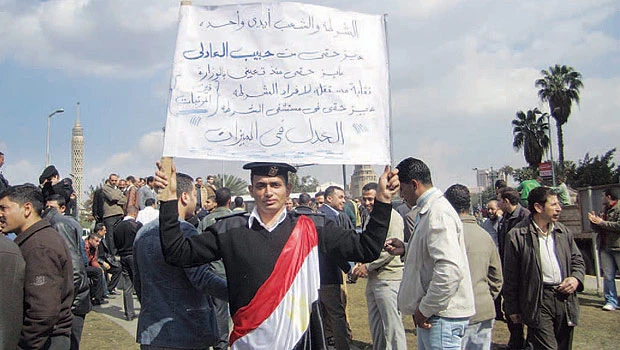
"They have definitely started to offer us what we wanted," said activist Sally Touma, reflecting a mix of caution and optimism among the protesters. Thousands have remained in Cairo's central Tahrir Square to demand immediate steps by the council such as the repeal of repressive emergency laws that give police broad power.
The suspension of the constitution effectively puts Egypt under martial law — where the military makes the laws and enforces them in military tribunals. The ruling council is expected to clarify the issue in upcoming statements and the role of civilian courts remains unclear.
Hossam Bahgat, director of the non-governmental Egyptian Initiative for Personal Rights, said the military's steps were positive but warned that Egypt was on uncharted legal ground.
"In the absence of a constitution, we have entered a sort of 'twilight zone' in terms of rules, so we are concerned," he said.
The ruling council said it will run the country for six months, or until presidential and parliamentary elections can be held. It said it was forming a committee to amend the constitution and set the rules for a popular referendum to endorse the amendments.
The last parliamentary elections in November and December were heavily rigged by the ruling party, virtually shutting out opposition representation.
"Our concern now in the Cabinet is security, to bring security back to the Egyptian citizen," Prime Minister Ahmed Shafiq told a news conference after the Cabinet meeting.
He said the military would decide whether Omar Suleiman, who was appointed vice president by Mubarak, would play some role in Egypt's transition. "He might fill an important position in the coming era," the prime minister said.
He also denied rumors that Mubarak had fled to the United Arab Emirates, saying the former president remained in the Red Sea resort of Sharm El-Sheikh. He went there just hours after stepping down.
Earlier, Egyptian troops scuffled with holdout protesters in Tahrir Square as the caretaker government sought to impose order, but outbreaks of labor unrest, including a police protest, underscored the challenges of steering Egypt toward stability and democratic rule.
Troops took down makeshift tents and made some headway in dispersing protesters who did not want to abandon their encampment in Tahrir Square, fearful that the generals entrusted with a transition to democratic rule will not fulfill all their pledges.
Still, the crowds of protesters were thinning out and traffic moved through the area for the first time. Many local residents shouted at the protesters that it was time to go.
The crowd on the square, the center of protests during the 18-day uprising, was down from a peak of a quarter-million at the height of the demonstrations to about 10,000 on Sunday.