- • Military rulers want constitution proposals within 10 days </br> • Best organized group Muslim Brotherhood plans political party</br> • Egypt’s government urges world to aid its economic recovery</br> • Country needs president in 40s or 50s: Mohamed El-Baradei</br> • Conflicting reports coming about health of ousted president
CAIRO: Egypt's new military rulers said on Tuesday they hoped to hand over power to an elected civilian leadership within six months and that they had no desire to keep control following the overthrow of President Hosni Mubarak.
The remarks carried on the state agency were the clearest indication since Mubarak was forced to resign that the high command was committed to a brief timeframe for meeting the demands of pro-democracy protesters for a new start.
“The Higher Military Council expressed its hope to hand over power within six months to a civilian authority and a president elected in a peaceful and free manner that expresses the views of the people,” an armed forces statement said.
The head of Highet Military Council also ordered on Tuesday a constitutional amendment committee to finish its work within 10 days, the state news agency reported.
Mohamed Hussein Tantawi, the head of the Higher Military Council, confirmed retired judge Tareq Al-Bishry as head of the committee formed by a decree on Tuesday.
“The resolution stipulates that the committee finish its work within 10 days,” the state news agency reported.
The committee, comprising eight senior judges, would study all clauses that required amending “to guarantee the fairness and democratic nature of elections for the presidency, Parliament and the Shura council.”
Existing political groupings are mostly weak and fragmented. The Muslim Brotherhood, which under the now-suspended constitution could not form a party, may be the best organized group but its true popularity has yet to be tested.
“When the popular demand for the freedom to form parties is realized, the group will found a political party,” the Brotherhood said in a new statement.
Signaling the transformation in Egypt, state television aired an interview with senior Muslim Brotherhood member Essam El-Erian, something unimaginable in the Mubarak era.
Pro-democracy leaders plan a big “Victory March” on Friday to celebrate the revolution — and perhaps also to remind the military of the power of the street.
Wael Ghonim, a Google executive who had been detained for his part in the uprising, said military council members had told youth leaders that a referendum would be held on constitutional amendments in two months, a prelude to holding elections.
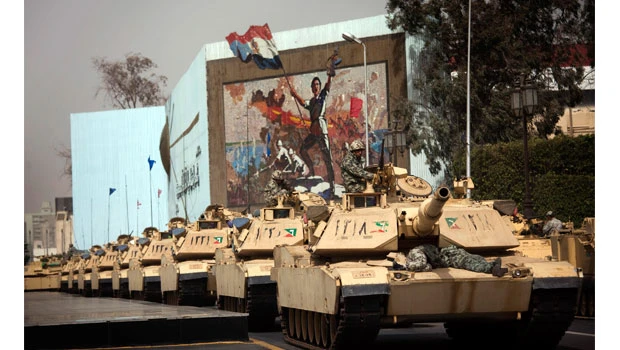
In Tahrir Square traffic flowed freely on Tuesday. Army tanks and armored vehicles around the square and other Cairo locations have now been sandbagged into position.
Conflicting reports are coming about Mubarak’s health. Asharq Al-Awsat said on Tuesday Mubarak’s health is deteriorating and he has refused to travel abroad for treatment. But Reuters quoted an anonymous source as saying Mubarak is in the Red Sea resort of Sharm El-Sheikh and taking telephone calls. “He’s fine,” the source said. “He is at his residence in Sharm with his family. He is receiving telephone calls. I spoke to him at 3 o’clock (1300 GMT) this afternoon.” Earlier, a military source told Reuters Mubarak was “breathing” but would not give details about his status.
Another Egyptian source with links to the family said he was not well but did not elaborate. “What is certain is that his state of health is declining drastically, in addition there is information that he is refusing to receive the required medical treatment,” Asharq Al-Awsat said in its online edition, quoting a former security official affiliated to the Egyptian military high command.
The report said Mubarak had refused advice to travel to Germany for treatment.
“Mubarak is refusing this (travel abroad),” the paper said, quoting its source. “He has asked those around him to allow him to die in his country, and I believe this is just a matter of time.”
Reformer Mohamed El-Baradei said his personal goal was to help build a democratic Egypt rather than bid for the presidency, and said the country's next leader should be in their 40s or 50s. “My only goal is to see my country transition from the path of oppressive dictatorship to a civilized ... and democratic state,” he told Al Jazeera.
“I hope the president will be in his 40s or early 50s,” said the 68-year-old retired diplomat.
“I will of course not nominate myself for the president of the republic by myself,” he said. “I do not desire to be president.”
Foreign Minister Ahmed Abul Gheit on Tuesday called on the international community to help speed Egypt's economic recovery.
Abul Gheit has called on “international parties to provide aid to the Egyptian economy, which has been severely affected by the political crisis that has shaken the country,” his ministry said in a statement.