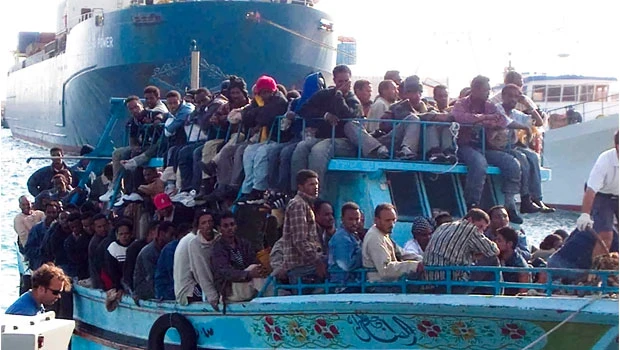
- TUNIS: Tunisia accepted technical help from Rome on Tuesday to stem the tide of illegal migrants who have been landing on an Italian island since Tunisians overthrew their president.
European Union estimates say 5,500 people from Tunisia have arrived illegally in Italy in the past few days, an influx the Italian government has called a humanitarian emergency and blames on turmoil inside Tunisia.
In a sign that security was gradually improving, Tunisia’s Interior Ministry said it was lifting a night-time curfew imposed at the height of the protests which brought down President Zine Al-Abidine Ben Ali last month.
European governments have for years relied on tough measures by entrenched North African leaders to keep out illegal migrants. Ben Ali’s overthrow, and subsequent disarray in Tunisia’s security forces, upset the arrangement.
Italian Foreign Minister Franco Frattini, after talks with Tunisian caretaker Prime Minister Mohamed Ghannouchi, said the two countries had agreed on a framework for cooperation on migrants that “respects Tunisia’s sovereignty.”
Under the deal, Italy would give Tunisia practical aid including “a network of radars and fast boats that will be operated by Tunisians,” Tunisia’s official TAP news agency quoted Frattini as saying on a visit to Tunis.
The two sides appeared to have papered over a diplomatic row that flared after Italy’s interior minister suggested Rome could send its police to the North African country. Tunis said that infringed on its sovereignty.
Tunisian protesters ended Ben Ali’s 23 years in power on Jan. 14, in a popular uprising that served as an inspiration for the revolt in Egypt which forced President Hosni Mubarak to resign last week.
Since Ben Ali’s departure Tunisia’s interim government has been making faltering steps toward stability. But police have melted away in many places, and strikes and protests around the country are disrupting the economy.
Tunisia this week deployed soldiers to stretches of coastline from where the migrants, often in overcrowded and rickety boats, were setting off for the Italian island of Lampedusa, which lies off the North African coast.
European Commissioner for Home Affairs Cecilia Malmstrom said in a speech the number of people reaching Italy had reportedly dropped in the past 24 hours.
“We are ready to assist both Italy and Tunisia. This is a matter of great importance for the EU,” she said.
The EU’s foreign policy chief, Catherine Ashton, said in an article in the Financial Times that she was in discussions with the European Investment Bank to mobilise 1 billion euros ($1.35 billion) for Tunisia this year.
That would be double the annual average the bank, which is the EU’s financing arm, lends to Tunisia.
The Tunisian government’s lifting of the night-time curfew follows pressure from the tourism industry — one of the Mediterranean country’s biggest sources of revenue — which said the restriction was scaring off visitors.
But in an indication of the lingering instability, the Interior Ministry said it would keep a state of emergency in force until further notice.
That measure forbids gatherings of more than three people in the street and allows troops to shoot at anyone who does not obey their instructions.
Keeping the emergency powers was necessary “as part of vigilance against anything that could threaten the safety of the country and its citizens and jeopardise public order,” the ministry said in a statement.