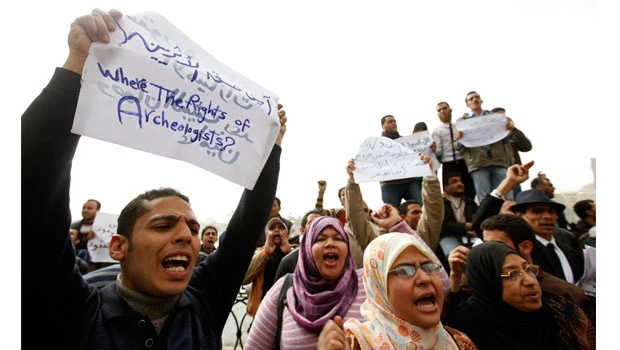
- CAIRO: Labor unrest unleashed by Hosni Mubarak’s ouster flared again Wednesday in Egypt despite a warning by the ruling military that protests and strikes were hampering efforts to improve the economy and return life to normal.
The ruling military council issued its second statement in three days calling for an immediate halt to all labor unrest. The new warning Wednesday raised expectations of an outright ban on protests and strikes that could raise the tension level in a country already growing more nervous by the day over uncertainties about the future.
The council that took power from longtime leader Hosni Mubarak on Friday says strikes and protests are hampering efforts to salvage the economy and return to normal life after the 18-day democracy revolt that forced the president out of office.
"We urge citizens and members of professional and labor unions to go on with their jobs, each in their position," a text message sent to Egyptian cellphones from the military said.
So far, the warnings have been defied by people airing grievances everywhere over just about everything, from meager wages to police brutality and corruption.
Hundreds of Cairo airport employees protested inside the arrivals terminal at Cairo International Airport to press demands for better wages and health coverage. Their protest did not disrupt flights.
In the industrial Nile Delta city of Mahallah Al-Koubra, workers from Egypt’s largest textile factory went on strike over pay and calls for an investigation into alleged corruption at the factory, according to labor rights activist Mustafa Bassiouni.
Mahallah in April 2008 witnessed the country’s largest protests in decades, when demonstrators seeking better pay and a check on rising food prices. The youth movement behind the Mahallah protest then was a key player in the 18 days of anti-Mubarak protests that broke out Jan.. 25 and eventually forced the longtime authoritarian leader to step down.
In Port Said, a coastal city at the northern tip of the Suez canal, about 1,000 people demonstrated to demand that a chemical factory be closed because it was dumping waste in a lake near the city.
Egypt's economy is in virtual paralysis with the labor unrest, extended bank and stock market closures and an evaporation of tourism — a key source of income for the country.
Authorities decided to put back by another week the reopening of schools and universities across the country, an indication that the country still has some way to go before it returns to full normalcy. Schools and universities were just starting their midyear break when the protests broke out.
Banks remained closed Wednesday and would remain shut Thursday, the last day of the business week in Egypt. There was no word on whether they would reopen Sunday, the start of the business week.
The stock market has been closed for the past three weeks and, again, there was no word on when it would resume operating. The market lost nearly 17 percent of its value in two tumultuous sessions in late January before it was ordered shut to halt the slide.
The European Union said its foreign policy chief Catherine Ashton would visit Egypt next week after the Egyptian Foreign Ministry asked the international community for aid.
In Geneva, the Swiss Justice Ministry said Switzerland has received a formal request from Cairo concerning the assets of Mubarak and "representatives of the former regime." "A rogatory commission has been transmitted to us," said Folco Galli, spokesman of the ministry. "It concerns the representatives of the former regime," he added, without giving their names.
Switzerland had taken pre-emptive action to freeze the assets of Mubarak and his entourage on Feb. 11, barely two hours after the president stepped down. Twelve people were hit by the move, including Mubarak's immediate family members as well as four ministers.
Galli said that Egypt's request was being examined, and would be executed "if it satisfies formal conditions."
Meanwhile, reporters at Egypt's state-owned Al-Ahram daily, long considered the propaganda arm of the regime, apologized for its "unprofessional" coverage of protests that ousted Mubarak.
Al-Ahram "would like to apologize to readers and to the great people of Egypt for its unprofessional and unethical editorial policy during the January 25 Revolution, 2011," they said, in a statement signed by 300 journalists.
They said journalists at the paper had for decades been "hostage to senior managers, chosen unprofessionally, on the basis of loyalty to the leader, his family, the ruling party and the security services."