
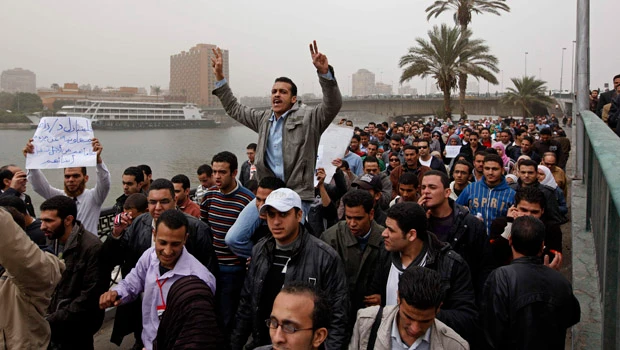
- CAIRO: Egypt’s transitional government — struggling to restore normalcy after three weeks of turmoil — faces no less formidable a challenge trying to right an economy reeling from the combined impact of shutdowns and strikes, as well as higher inflation and capital flight.
A survey of forecasters taken by The Media Line before unrest broke out saw Egypt’s gross domestic product on track to expand 5.7 percent in 2011.
But David Cowan, economist at Citigroup Global Markets in London, said the combined effect of lost output and higher inflation eating into people’s income will likely trim growth this year to 1.5 percent.
“That’s a significant falloff,” Cowan said.
“It would be very difficult to see growth become negative unless there is a war or something that really damages the economy. But at that rate you’ll be seeing stagnant incomes, because population growth is about 1.5 percent.”
That will almost certainly complicate efforts by a transitional government to stabilize Egypt and lead the country into promised elections later this year.
Many Egyptians – 40 percent of whom live on $2 a day or less - are counting on the new regime to raise wages, create jobs and contain soaring prices for food and fuel.
As the protests at Tahrir Square wind down, the country has become beset by strikes by everyone from police and ambulance staff to textile workers and employees of the Suez Canal.
In a communiqué read out on state television recently, a spokesman for the Supreme Council of the Armed Forces called for “national solidarity” and criticized the strikes.
In addition, banks remained closed on Wednesday and are expected to remain so on Thursday, the last day of the business week in Egypt. There was no word on whether they would reopen Sunday. The stock market has been closed for the past three weeks.
The tourism industry, which is Egypt’s single-biggest money maker, remains virtually shut down and unlikely to recover until the unrest is over and political certainty returns, said Jean-Paul Pigat, head of Middle East and North Africa analysis, at Business Monitor International in London.
He estimated that Egypt’s GDP growth in the current fiscal year, which ends in June, would slow to 3.2 percent from a previous forecast of 5.1 percent.
Aside from domestic turmoil, Egypt’s economy faces the inflationary impact of climbing global prices for food and energy.
Higher petroleum prices will boost revenues from the Suez Canal, a major route for the world oil trade, and lift incomes and job prospects for Egyptians employed in the Gulf, Cowan said.
But steeper inflation will cut into people’s income, reducing their purchasing power, he said.
He forecasted consumer prices rising to a 15 percent year-on-year rate by the end of 2011 from an average of 11 percent last year.
However, Pigat said the most serious immediate problem facing the government was the flight of capital out of the country.
Investors moved hundreds of millions of dollars out of the country on Jan. 26 and 27, prompting the central bank to shut the country’s banks for a week. Although Egypt’s Commercial International Bank (CIB) said on Tuesday its clients transferred abroad only 25 percent of what it had been preparing for, Pigat and other analysts said the flow was likely to resume. The re-opening of the stock market could boost it.
“It’s undeniable that capital is flowing out of the economy, which is one of the reasons they were forced to close the banks,” Pigat said.
“That’s the biggest risk to the economy going forward. It has pronounced implications for balance of payment and Egyptian pound.”
In Egypt’s favor, the central bank has $35 billion of foreign currency reserves, enough to cover seven months worth of imports. That, together with possible imposition of currency controls, could prevent a severe depreciation of the Egyptian pound, Pigat said.
But otherwise, Egypt’s government will be strapped for funds to address the economy. Before the outbreak of unrest, it was running a budget deficit equal to eight percent of GDP, which Moody’s Investors Service termed “stretched” when it cut the country’s credit rating Jan. 31. Cowan said that could reach as much as 11% this year.
A fund manager said the kind of things the government needed to do in order to assuage protesters would be economically beneficial and require policies that are business-friendly so as to encourage foreign direct investment (FDI).
“People in the streets are asking for three things - to improve the poverty situation, for jobs and free elections,” the fund manager said.
“The first two are economic drivers - higher employment and more subsidies for basic needs. The government doesn’t have resources to boost subsidies without higher taxes. But, if they increase taxes, there will be less spending and fewer job opportunities. That means they will turn to FDI.”
But Pigat said he was less optimistic because Egypt’s military is in control of the transition and might continue to wield power even after elections. The army owns vast swathes of the economy, including land, factories and tourism enterprises and will be loathe to cede it to the private sector or to increased competition.
“We don’t have any certainty that any new government will be more business friendly or more willing to push through business reforms,” Pigat said.