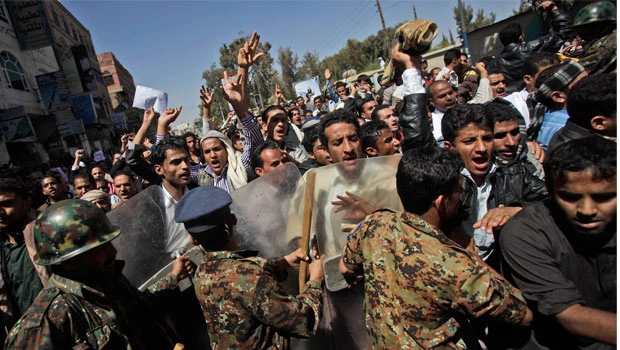
- SANAA: At least four people were killed and scores were injured in Yemen on Friday as anti-government protesters rallied for President Ali Abdullah Saleh's resignation and pro-government loyalists came out in force.
At least eight people were reported injured, including a journalist and his cameraman, in clashes in Sanaa, but numerous bloodied people were seen stumbling away from the melee.
In the southern port city of Aden two anti-Saleh demonstrators were shot dead and three others were injured, bringing the total there to five dead in two days. On Friday, police had opened fire on demonstrators who were calling for the prosecution of those responsible for Thursday's deaths.
In Taiz, two protesters were killed and more than 20 injured when someone tossed a grenade at a gathering of thousands of demonstrators who had barricaded the streets for more than a week calling for Saleh to step down. The attacker fled but was later arrested by police.
At least 48 protesters were seriously wounded, and many others were hurt as they fell in the stampede and chaos, according to medical officials and Ghazi Al-Samie, a lawyer and activist in Taiz, Yemen’s second-largest city.
“It’s shameful the government resorts to such tactics, but it won’t scare us,” said a protester who asked not to be named.
“Down with the dictator, down with oppression,” chanted the protesters camped for days in Taiz’s Hurriya (freedom) Square in imitation of Egyptian demonstrators in Cairo’s Tahrir Square.
The pro-and anti-government sides attacked each other with rocks, and the riot police began firing in the air and launching tear gas canisters.
At least 10,000 Saleh loyalists also took to the streets of Taiz — state television put the number at a million.
“Yes to unity and stability, no to chaos and sabotage,” the loyalists shouted, echoing remarks made by Saleh a few days ago warning of a “foreign agenda” to create chaos in the Arab world.
Following the attack, pro and anti-government media exchanged accusations for the attack. Al-motamar.net, the mouthpiece of the ruling party, accused opposition figures of sending the man to carry out the attack and distributing weapons in another governorate to spread chaos and sabotage across the country. On the other hand, opposition websites claimed that many of the leading party figures encouraged the man to throw the bomb in order to intimidate the demonstrators.
Some analysts see Taiz, which has a sizeable middle class and residents from both north and south, as a barometer for the protest movement in Yemen, which has gathered strength since Tunisians and Egyptians toppled their presidents this year.
“Sanaa is important, but if Taiz really gets going this thing could take off,” Gregory Johnsen, a Princeton University scholar, said in his blog on Yemen, Waq Al-Waq.
In Sanaa, thousands of anti-Saleh protesters marched down University Street, shouting “You’re next after Mubarak, Ali” and holding signs saying “Leave, leave for the sake of our future.”
Hundreds of Saleh loyalists gathered near Sanaa University, shouting “No to chaos, no to sabotage,” as a small group broke away and attacked anti-Saleh protesters with sticks and rocks.
Opposition and loyalist sources said dozens of people had been hurt in the Yemeni capital.
In the capital Sanaa, the scene of a sixth straight day of demonstrations, several journalists were severely beaten by supporters of the ruling General People's Congress who attacked the demonstration using batons and axes, an agency report said.
Thousands of demonstrators, mostly students, had gathered following Friday prayers in a main street of Sanaa. "People want to overthrow the regime," they chanted.
In the southern city of Mukallah, police dispersed with batons and tear gas a peaceful demonstration by separatists in the city's downtown. Three people were injured.
Witnesses said one protester died from gunfire and four were wounded as police tried to disperse crowds in the southern city of Aden, where resentment against rule from Sanaa runs high.
Thousands rallied in various parts of Aden, angered by the killings of six people earlier this week and chanting anti-Saleh slogans such as “Ali, listen, the people want you out.”
In Aden, protesters burned four government cars and a local council building. The clashes continued well after sundown, when protesters set a police storage area ablaze and burned tires.
The police fired into the crowd, using tear gas, rubber bullets and what some witnesses said was live ammunition.
Three protesters were killed — including two in their 20s who were shot, according to witnesses and medical officials who spoke on condition of anonymity because they were not authorized to talk to the press.
A large demonstration also was reported in eastern Hadramawt province, where police fired in the air to disperse protesters.
The violence forced international soccer officials to postpone Yemen’s Feb. 23 home qualifying match for the 2012 Olympics against Singapore. The match, in Sanaa, was put off until March 2.
Saleh, a weak but important partner for Washington, had pledged not to seek re-election in 2013 or pass power to his son. The promise was seen as an attempt to defuse calls for his ouster. Opposition groups said they are suspicious of Saleh’s offer and want concrete proposals for change.
Tribal chief Hussein Al-Ahmar, a member of Saleh’s tribe, told a crowd in his home province Thursday that if violence against protesters continued, his tribesmen may come in to the defense of the demonstrators.
The threat, apparently aimed to get more concessions from Saleh, could turn the protests more violent. Al-Ahmar’s tribe, Hashed, is one of the largest and best-armed in Yemen.
“It is not the armed forces, nor Saleh and his army that protect Sanaa, but the tribes of Hashed” and others, Al-Ahmar told the crowd in Amran province. “If the authorities continue to scare the protesters with their thugs, we will have to interfere.”
Journalists also came under attack by government supporters. An Associated Press reporter saw men with sticks attack a TV crew, smashing their camera. Other photographers took refuge in a building to avoid the mob.
A correspondent for Saudi-owned al Arabiya television said plainclothes security men had attacked him and his cameraman.
“We were both badly beaten. They took the camera and smashed it to bits,” Hamoud Munasser told Reuters in Sanaa.
Saleh, whose country is mired in poverty, is also struggling to quash Al-Qaeda militants, defuse a southern separatist revolt and maintain a shaky truce with northern Shiite rebels.
In a sop to protesters, he has promised to step down when his term ends in 2013 and not to hand power to his son.
A coalition of opposition parties, which had laid on rallies that drew tens of thousands, has now agreed to talk to him, but smaller, more spontaneous protests have continued, organized by students and others using mobile text messages and Facebook.
Yemen has become a main battleground against Al-Qaeda. The government, which receives millions of dollars in US military aid, has allowed American drone strikes on Al-Qaeda targets and has stepped up counterterrorism cooperation.
The US -born radical cleric Anwar Al-Awlaki, thought to be hiding in Yemen, is believed to have inspired and even plotted or helped coordinate recent attacks on the US
Those include the failed December 2009 bombing of a Detroit-bound airliner and the unsuccessful plot to send mail bombs on planes from Yemen to the US Al-Awlaki also is believed to have inspired the 2009 shooting at Fort Hood, Texas, and had ties to some of the 9/11 hijackers.
Nearly half of Yemen’s population lives below the poverty line of $2 a day and its government is riddled with corruption. The country also is plagued by shrinking water and oil resources and an inability to feed its people.
Poverty and malnutrition are rampant in the country’s rugged hinterlands.