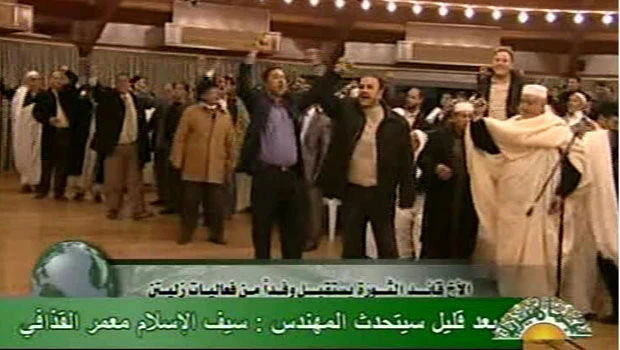
- CAIRO: After anti-government unrest spread to the Libyan capital and protesters seized military bases and weapons Sunday, Moammar Qaddafi’s son went on state television to proclaim that his father remained in charge with the army’s backing and would “fight until the last man, the last woman, the last bullet.”
Seif Al-Islam Qaddafi, in the regime’s first comments on the six days of demonstrations, warned the protesters that they risked igniting a civil war in which Libya’s oil wealth “will be burned.”
The speech followed a fierce crackdown by security forces who fired on thousands of demonstrators and funeral marchers in the eastern city of Benghazi in a bloody cycle of violence that killed 60 people on Sunday alone, according to a doctor in one city hospital.
Since the six days of unrest began, more than 200 people have been killed, according to medical officials, human rights groups and exiled dissidents.
Lybia’s response has been the harshest of any Arab country that has been wracked by the protests that toppled long-serving leaders in neighboring Tunisia and Egypt. But Qaddafi’s son said his father would prevail.
“We are not Tunisia and Egypt,” the younger Qaddafi said. “Moammar Qaddafi, our leader, is leading the battle in Tripoli, and we are with him.”
“The armed forces are with him. Tens of thousands are heading here to be with him. We will fight until the last man, the last woman, the last bullet,” he said in a rambling and sometimes confused speech of nearly 40 minutes.
The younger Qaddafi, who is the regime’s face of reform, conceded that the army made some mistakes during the protests because the troops were not trained to deal with demonstrators, but he added that the number of dead had been exaggerated, giving a death toll of 84.
Western countries have expressed concern at the rising violence against demonstrators in Libya. British Foreign Secretary William Hague said he spoke to Seif Al-Islam Qaddafi by phone and told him that the country must embark on “dialogue and implement reforms,” the Foreign Office said.
In the speech, the younger Qaddafi offered to put forward reforms within days that he described as a “historic national initiative” and said the regime was willing to remove some restrictions and begin discussions for a constitution. He offered to change a number of laws, including those covering the media and the penal code.
Protesters had seized some military bases, tanks and other weapons, he said, blaming Islamists, the media, thugs, drunks and drug abusers, foreigners — including Egyptians and Tunisians.
He also admitted that the unrest had spread to Tripoli, with people firing in central Green Square before fleeing.
Communications are tightly controlled and Benghazi is not accessible to international journalists, but the picture that has emerged is of a city slipping from the grasp of security forces in the biggest challenge to Qaddafi’s rule since the “brotherly leader” seized power in a 1969 military coup.
Sunday’s violence took place after residents took to the streets in their thousands to bury scores of dead killed in the previous 24 hours. The United States said it was “gravely concerned” by what it called credible reports hundreds of people had been injured or killed.
“Libyan officials have stated their commitment to protecting and safeguarding the right of peaceful protest. We call upon the Libyan government to uphold that commitment and hold accountable any security officer who does not act in accordance with that commitment,” said State Department spokesman Philip Crowley.
In a rare sign of dissent, Libya’s representative to the Arab League quit in protest over “oppression against protesters,” Al Jazeera television reported.
Human Rights Watch said 84 people were killed in Benghazi on Saturday, bringing the death toll in four days of clashes mainly in the country’s east to 173 — before Sunday’s fresh violence.
“A massacre took place here last night,” one resident, who did not want to be named, told Reuters by telephone on Sunday.
A leading tribal figure who requested anonymity said security forces, mainly confined to a compound, had been venturing out of their barracks and shooting protesters in the street in “cat and mouse chases.”
Clashes were taking place on a road leading to a cemetery where thousands had gone to bury the dead. “The situation is very tense and scattered fires have erupted in revolutionary committee headquarters and other buildings,” he said.
The crackdown prompted about 50 Libyan Muslim religious leaders to issue an appeal, sent to media, for the security forces, as Muslims, to stop the killing.
“We appeal to every Muslim, within the regime or assisting it in any way, to recognize that the killing of innocent human beings is forbidden by our Creator and by His beloved Prophet of Compassion (peace be upon him) ... Do NOT kill your brothers and sisters. STOP the massacre NOW!” the appeal said.
Libya is a major energy producer with significant investment from Britain’s BP Plc, Exxon of the United States and Italy’s ENI among others.
British Foreign Secretary William Hague urged Libya to begin dialogue with anti-government protesters and implement reforms, in a phone call to a son of Qaddafi on Sunday.
In Brussels, the Hungarian EU presidency said Libya had told the European Union it would stop cooperation with the bloc in stemming illegal migration to Europe if the EU encourages pro-democracy protests in the country.