- MANAMA: The March opening race of the Formula One season in Bahrain was canceled on Monday, as the country’s opposition prepared to press for change in country’s leadership, backed by protesters camped out in streets.
The March 13 race was thrown into doubt after mainly Shiite protesters took to the streets of the capital of Manama a week ago, demanding political reform and energized by popular revolts that toppled the rulers of Tunisia and Egypt.
“At the present time the country’s entire attention is focused on building a new national dialogue for Bahrain,” Crown Prince Sheikh Salman bin Hamad Al-Khalifa said in a statement.
“After the events of the past week, our nation’s priority is on overcoming tragedy, healing divisions and rediscovering the fabric that draws this country together,” said Salman, who was appointed by King Hamad bin Isa Al-Khalifa to lead a national dialogue.
Plans by an exiled Shiite leader to return home raised the stakes in a power struggle in the island nation as Haq movement leader Hassan Mushaimaa, tried in absentia in Bahrain for attempting to topple the government, said he would fly back from London on Tuesday.
Mushaimaa’s Facebook page said he wanted to “see if this leadership is serious about dialogue and if it will arrest him or not.” An arrest warrant for Mushaimaa is outstanding.
King Hamad bin Isa Al-Khalifa has asked his son, the crown prince, to conduct a dialogue with all parties, but after the bloodshed on the streets, in which seven people were killed and hundreds wounded, opposition parties are wary.
Haq is more radical than the Shiite Wefaq party, from which it split in 2006 when Wefaq contested a parliamentary election. Wefaq’s 17 MPs resigned last week in protest at the violence.
“They (Haq) are less likely to take a conciliatory position toward the regime,” Shadi Hamid of the Doha Brookings Center said. “They are not yet explicitly calling for its downfall, but they are not interested in being part of the system.”
Haq’s leaders often have been arrested in recent years, only to receive royal pardons. Some were rearrested in a crackdown in August, when 25 Shiite activists, including 23 now on trial, were charged with trying to overthrow the government violently.
In a rare protest in nearby Kuwait, dozens of demonstrators waving Bahraini and Kuwaiti flags gathered in front of parliament in support of Bahraini protesters, a resident said.
One carried a picture of an injured protester, with the text: “Where is democracy?” They later dispersed peacefully.
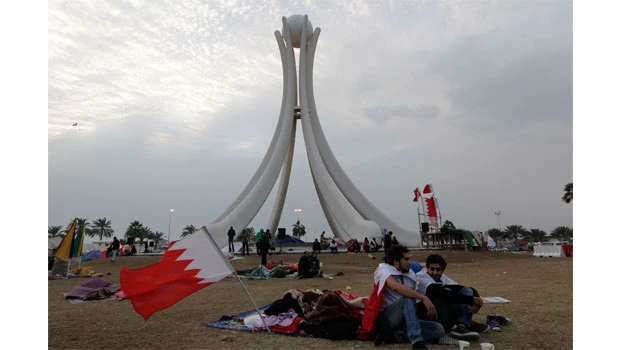
Up to 10,000 people again packed Pearl Square, at the heart of week-long protests led by majority Shiites demanding more say in the Gulf Arab country.
More than 1,500 striking teachers joined them to back demands for change. “No teaching until the government falls,” they chanted.
The opposition is demanding a true constitutional monarchy that gives citizens a greater role in a directly elected government. It also wants the release of political prisoners.
“In the eyes of the people the government has already fallen,” said Amir Ahmed, 38, a government oil-sector employee.
The demonstrators in Pearl Square were impatient for change after seeing entrenched rulers in Egypt and Tunisia depart.
Lamia, a 26-year-old primary school teacher, said Bahrain would also topple its leaders. “We are much stronger than them and we hope it will happen as soon as possible,” she said.
US Secretary of State Hillary Clinton condemned any attempt by Bahraini security forces to crush peaceful protests on the island, which hosts the US Navy’s Fifth Fleet.
“We’ve been very clear from the beginning that we do not want to see any violence. We deplore it. We think it is absolutely unacceptable,” she told ABC News on Sunday.
The Al-Khalifa family, which has ruled Bahrain for 200 years, dominates a cabinet led by the king’s uncle, who has been prime minister for 40 years since independence in 1971.
“The Bahraini regime is still behind the curve,” Hamid said. “They are not willing to meet the demands of protesters, even something simple like sacking the prime minister.”