- SANAA: As demonstrations ratcheting up pressure on Yemeni President Ali Abdullah Saleh to leave office, the leader offered new concessions in a bid to stem the tide against him by setting up on Thursday night a committee headed by prime Minister Ali Mujawaer assigned to embark on reconciliation talks.
The committee is due to meet with demonstrators in the capital, Aden and Taiz, according to Saba News Agency. The committee is expected to meet the demonstrators and raise their demands to the president. However, there is no indication in this move that the protesters’ top demand — Saleh's exit — would be met.
Saleh discussed in his meeting with senior officials ways of combating unemployment and inflation and providing incentives for university students and entrepreneurs.
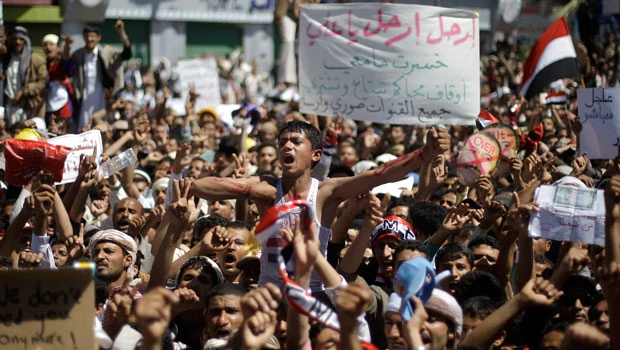
On Friday, thousands of pro-democracy protesters amassed in the street after prayers, calling for Saleh to step down by next Friday.
Saleh ordered police on Wednesday to keep their distance from demonstrators and head off any scuffles between the anti-government demonstrators and loyalists.
In Aden, where the situation remains tense after recent fatalities, tens of thousands of anti-government demonstrators streamed into the streets carrying the body of one the demonstration's victims. Local sources reported one dead and 10 injured. Demonstrations calling for Saleh's ouster were also organized in the strongholds of the southern secessionists movement in Abyan, Lahij and Mukalla.
National TV aired photos of throngs of people hoisting the national flag and Saleh's photos. Similar demonstrations were organized in the northern provinces of Ibb and Hajja. Yemen security services were directed to keep vigilance and take all deemed precautions to prevent any infiltration of Al-Qaeda militants into the capital who might use the demonstrations to commit terrorist acts.
Protesters outside Sanaa University, repeating slogans which have echoed round the Arab world since the uprisings in Egypt and Tunisia, chanted: “The people demand the downfall of the regime.”
About 4 km across town, loyalists shouted support for a leader they said was holding the fractured and impoverished tribal country together. “The creator of unity is in our hearts. We will not abandon him,” they chanted.
Seventeen people have died in the past nine days in a sustained wave of nationwide anti-Saleh protests galvanized by the fall of the Tunisian and Egyptian presidents. Saleh has said he will not give in to “anarchy and killing.”
The Yemeni leader is struggling to end protests flaring across the Arabian Peninsula’s poorest state.
He is also trying to maintain a shaky truce with northern rebels and contain a secessionist insurgency in the south against northern rule.
In the south of the country, more than 10,000 people took to the streets in various districts of the port city of Aden, demanding an end to Saleh’s rule.
Nine people were injured in the protests, witnesses said, and security forces blocked off the city to prevent people from neighboring cities from joining them.
In the city of Taiz, 200 km south of the capital, about 10,000 people staged an anti-government protest.
Outside Sanaa University, Saleh’s opponents held an auction to raise money for their campaign, selling a car and a watch, which fetched 600,000 riyals ($3,000).
“The revolution has started. It will not stop until all of our demands are met,” said Fouad Dahaba, an opposition member of Parliament who attended the rally. “We are not less than the people of Tunis and Egypt, who were emancipated.”
Saleh supporters in Tahrir Square, many of whom arrived in buses, chanted “Yes to stability, no to chaos.”
“There is no use in trying to destroy the country and divide it. We all must enter a dialogue to preserve the national interest,” said Mohammad Saleh.
Authorities stepped up security in Sanaa ahead of the rallies. An Interior Ministry statement late Thursday ordered security forces to “raise their security vigilance and take all measures to control any terrorist elements” who might take advantage of the protests to infiltrate Sanaa.
Saleh had earlier “demanded security services offer full protection for the demonstrators” and prevent confrontations, according a statement from Yemen’s Washington Embassy.
Pro-Saleh loyalists wielding clubs and daggers have often sought to break up opposition protests in Sanaa and elsewhere.
Hours after the embassy statement was issued, a bomb exploded at a protest march by southern secessionists in the town of Lawdar on Thursday, killing one person and wounding two, a local official said.
A man who had set himself on fire earlier this week died of his burns at a hospital in Aden the same day, a doctor said. The man’s relatives said he had acted in protest against the killings of demonstrators in the southern port city.
State news agency Saba said Saleh has also assigned a committee headed by Prime Minister Ali Mohammed Megawar to open a dialogue with protesters to hear their demands.
Nine members of parliament resigned from Saleh’s ruling party on Wednesday in protest against what they said was government violence against protesters, but the president still has the support of around 80 percent of parliamentarians.