- WASHINGTON: It has become clear that the unprecedented popular uprisings in Tunisia and Egypt and other countries of the region were enabled by communication and citizen mobilization via social media platforms — Twitter, Facebook, and YouTube — as well as mobile technology.
And digital media, by all accounts, will thrive in the Arab market because the market has a large, technologically accomplished demographic group — its youth — who are comfortable with it and will customize it to their own requirements, the 'Arab Media Outlook 2008-1012,' published by the Dubai Press Club, recently reported.
The report also said that more than 50 percent of the populations of Yemen, Oman, Saudi Arabia, Jordan, Morocco, and Egypt are currently estimated to be less than 25 years of age, while in the rest of the Arab region, the under-25 “Net Generation” makes up between 35 to 47 of total populations.”
As for active blogs, the Arab region had 35,000 blogs in 2009, by late 2010, it had 40,000.
The effect of the social media phenomenon in the Middle East was understood before the recent shakeup around the Middle East. “Facebook and other social media platforms are beginning to define how people discover and share information, shape opinion, and interact,” said Carrington Malin, an executive at Spot On Public Relations in Dubai in May 2010.
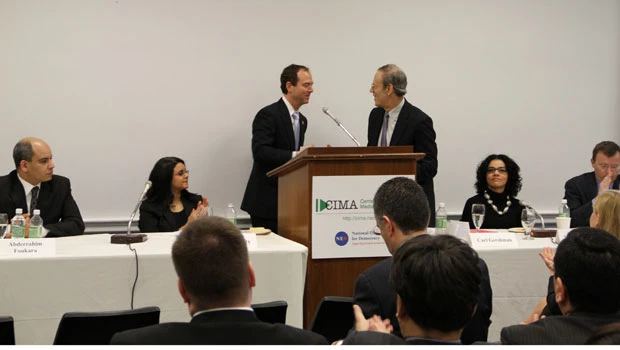
This week in Washington, the Center for International Media Assistance, CIMA, part of the National Endowment for Democracy, gathered media experts to examine the current role of the social media in the Arab world.
At the conference, CIMA's Senior Director, Marguerite Sullivan, pointed out that governments have long struggled with this new flow of information.
She quoted Wael Ghonim, a Google executive in Egypt, who said the Egyptian Interior Ministry had maintained a department of 45 people to monitor Facebook, a difficult task as over 5 million Egyptians use the social networking site among 17 million people in the region, including journalists, political leaders, political opposition figures, human rights activists, social activists, entertainers, and royalty who are engaging online in Arabic, English, and French.
Why this is significant is that many observers now believe that the days of government-sponsored or politically allied newspapers having a media monopoly appear to have already been eclipsed by the advent and adoption of social media.
Mona Eltahawy, an award-winning columnist and blogger on the MENA region, told CIMA's audience that social media have provided a virtual space for young people to openly express their opinions, including their frustration with unemployment and corruption.
Citizens have been using these tools in a much more political way than their Western counterparts since 2005, she argued, saluting their courage and highlighting the importance of citizens' agency and voice.
“Egypt and many Arab countries have gone through several media revolutions,” Eltahawy said, “and they have now been supplanted by the social media. Social media has enabled the masses to establish their own agenda.”
National Endowment for Democracy Program Officer for MENA, Amira Maaty, discussed how democracy activists are using digital tools to mobilize protesters and organize support.
She outlined the differences between citizen journalism and social media, which, together, can help push news items onto the agenda of state-sponsored outlets that might otherwise suppress the information; and digital activism, which uses mobile technologies to advance social and political change.
Maaty also stressed the importance of donors and policymakers supporting the innovators behind the technology, as well as the tools.
Georgetown University's Michael Nelson cautioned that leaders in authoritarian states can also use digital media to their advantage through cyber-surveillance and propaganda.
Al Jazeera's Abderrahim Foukara reminded the audience of the importance of satellite television in helping to “connect the dots” between digital and traditional media.
While it served to verify-or discount-reports on social media platforms, he said, it also covered events and perspectives that state media falsely reported or ignored. He stressed the ability of television to bridge access issues across generations and language/literacy barriers, highlighting its vital role in informing older and less technologically savvy citizens.
But print media is struggling. According to the Arab Media Outlook, 2009-2013, some print publications believe the future is online and are switching to online formats. Saudi Arabia's Al Majalla newspaper dropped its print edition to focus on an online newspaper format in 2009. As did the UAE sports magazine, Super, which also dropped its print edition in 2009.
Significantly, according to a recent survey by the Arab Advisors Group's Survey of Internet Use and Online Advertising, more readers prefer reading newspapers in Saudi Arabia and the UAE, while more read their newspapers online in Egypt and in Jordan.
Key Findings by the Center of International Media Assistance:
• About 17 million people in the Arab region are using Facebook, available in Arabic, with 5 million in Egypt alone. Twitter announced it will launch its Arabic interface in 2011.
• Arab governments are developing, at varying rates, the telecommunications infrastructure for greater Internet connectivity through broadband, mobile Internet, and fiber optic cable to the home for increased Internet speeds and capacities to meet future demands of the youth, who comprise about half of the regional population.
• Along with technical capacities come increasing efforts to monitor, filter, and block websites.
• Some Arab government officials and politicians are active contributors to social networking platforms such as Twitter and Facebook.
• Popularity of online news is gaining audience share from traditional news media, a proportion that is expected to grow as some media outlets have ceased print editions to focus on electronic editions.
• Indigenous social media platforms are striving to go beyond blogging, to bridge the virtual online world with the physical world by offering community-driven quality news, online video stories, and forums for greater interactivity around timely issues, as well as the showcasing of art and culture.